Annapurna Circuit vs Annapurna Base Camp Trek – Which One Should You Choose?
Annapurna Circuit vs Annapurna Base Camp Trek? When it comes to trekking in Nepal, the Annapurna region stands out as one of the most diverse and breathtaking trekking destinations in the Himalayas. Two of the most popular trekking routes in this region are the Annapurna Circuit Trek (ACT) and the Annapurna Base Camp (ABC) Trek. Both offer spectacular mountain scenery, authentic Himalayan culture, and memorable teahouse experiences, but they are very different in terms of route, duration, altitude, scenery, difficulty, and overall trekking experience.
If you are planning a Nepal trek and are unsure whether to choose Annapurna Circuit or Annapurna Base Camp, this detailed comparison can help you make the right decision.
Route and Duration: ABC vs ACT
The Annapurna Circuit Trek traditionally circles the Annapurna Massif and can cover approximately 160–230 km, depending on the starting and ending points and the itinerary selected. The trek can be completed in different lengths, ranging from shorter itineraries of around 8–14 days to longer versions lasting more than two weeks.
One of the biggest attractions of the Annapurna Circuit is the dramatic change in landscapes. The trail moves from subtropical valleys, waterfalls, forests, and terraced farmland into the high alpine environment of Manang and the dry, desert-like landscapes toward Mustang. The highlight for many trekkers is crossing the legendary Thorong La Pass at 5,416 meters.
The Annapurna Base Camp Trek, meanwhile, is generally shorter and can often be completed in around 7–10 days, depending on the starting point and itinerary. Instead of circling the entire Annapurna range, the trail leads into the spectacular Annapurna Sanctuary.
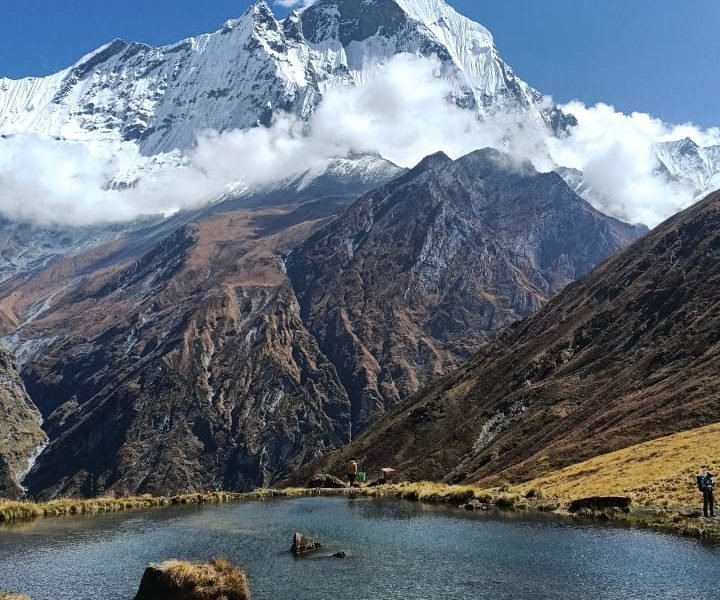
The Annapurna Sanctuary Trek takes you deep into a natural mountain amphitheater surrounded by enormous Himalayan peaks. The trail eventually reaches Annapurna Base Camp at approximately 4,130 meters, with magnificent views of Annapurna I, Machhapuchhre, Hiunchuli, Annapurna South, and surrounding peaks.
Choose ACT if: you want a long-distance Himalayan journey with constantly changing scenery.
Choose ABC if: you have limited time and want to reach the heart of the Annapurna mountains.
Scenery and Landscape
Both treks provide outstanding scenery, but the experience is quite different.
The Annapurna Circuit is famous for geographical and climatic diversity. In a single trek, you can experience lush green valleys, pine and rhododendron forests, dramatic cliffs, high mountain passes, glacial valleys, and the dry landscapes of Mustang. The transition from Hindu communities in the lower valleys to Tibetan-influenced Buddhist villages in the upper region adds another fascinating dimension.
Villages around Manang provide an opportunity to experience traditional Himalayan lifestyles, Buddhist monasteries, prayer wheels, mani walls, and spectacular views of Annapurna II, Annapurna III, Gangapurna, Tilicho Peak, and other mountains.
The ABC Trek is more concentrated on alpine scenery. The journey passes through terraced fields, forests, waterfalls, suspension bridges, and traditional Gurung and Magar settlements before entering the Annapurna Sanctuary. As you move higher, the mountains appear increasingly close and dramatic.
Reaching Annapurna Base Camp feels like entering a natural Himalayan amphitheater. The surrounding peaks rise dramatically on almost every side, making ABC particularly attractive for trekkers who prioritize close-up mountain scenery.
Altitude and Difficulty
Altitude is one of the most important differences between the two treks.
The Annapurna Circuit reaches its highest point at Thorong La Pass, 5,416 meters. Because the trek spends several days at progressively higher elevations, proper acclimatization is essential. The combination of long walking days, high altitude, and the steep ascent toward Thorong La makes ACT physically demanding.
The Annapurna Base Camp Trek reaches approximately 4,130 meters, considerably lower than Thorong La. However, that does not mean altitude should be ignored. Trekkers can still experience symptoms of altitude sickness, especially if they ascend too quickly.
Overall, ACT is generally considered more challenging, particularly because of its length and high pass. ABC is usually considered moderate, making it a popular option for trekkers who want a shorter Himalayan adventure.
Neither trek should be treated as a completely easy walk. Good preparation, gradual acclimatization, hydration, appropriate pacing, and awareness of altitude symptoms are important on both routes.
Culture and Local Experience
Culture is another major reason to choose either Annapurna trek.
The Annapurna Circuit offers one of the broadest cultural experiences in Nepal. Depending on your route, you encounter Gurung, Thakali, Manangi, and other Himalayan communities. Lower sections of the trail have strong Hindu cultural influences, while villages farther north feature Tibetan Buddhist traditions.
You can visit monasteries, chortens, prayer wheels, mani walls, and traditional villages while learning about the relationship between mountain communities and their environment.
The ABC Trek provides a more concentrated cultural experience, particularly among Gurung and Magar communities. Villages along the trail are known for their hospitality, traditional houses, local food, and distinctive customs.
If cultural and geographical diversity is your priority, the Annapurna Circuit has the advantage. If you want a shorter trek with strong Gurung cultural experiences combined with dramatic mountain scenery, ABC is an excellent choice.
Accommodation and Accessibility
Both routes have established teahouses and lodges where trekkers can find rooms and meals along the trail. Facilities become more basic as you move into higher and more remote areas.
The Annapurna Circuit traditionally begins around Besisahar and can be customized to start farther along the route because road transportation has changed access to several trailheads. Depending on the itinerary, the trek can finish toward Jomsom, Tatopani, or another point.
ABC is generally more convenient for travelers staying in Pokhara. The trek can begin from several trailheads in the lower Annapurna region, making it easier to fit into a shorter Nepal itinerary.
For travelers with only a week or so available for trekking, ABC is usually more practical.
Annapurna Circuit Trek Guide: Do You Need a Guide?
A guide can make a major difference on the Annapurna Circuit, especially because the route is long, altitude varies considerably, and trail and road conditions can change.
For a more detailed explanation of guide services, preparation, safety, and logistics, see the Annapurna Circuit Trek Guide.
A knowledgeable local guide can assist with accommodation, route navigation, acclimatization, weather information, communication with local communities, and emergency arrangements. The cultural value is equally important because a local guide can explain monasteries, villages, customs, and the history of the region rather than simply leading you along the trail.
If this is your first high-altitude trek, traveling with an experienced guide can provide additional confidence.
Annapurna Circuit vs ABC: Which Trek Has Better Mountain Views?
This depends on the type of scenery you prefer.
Annapurna Circuit is better for variety. You experience multiple climatic zones and mountain environments, from green valleys to dry high-altitude landscapes.
ABC is better for concentrated mountain scenery. Once inside the sanctuary, enormous peaks surround you, creating a dramatic feeling of being deep inside the Himalayas.
So, if you want to photograph different landscapes throughout your trek, choose ACT. If your dream is to stand directly beneath some of the world’s highest mountains, ABC may be the better option.
What About Everest Base Camp?
If you are comparing the Annapurna treks with Nepal’s other iconic Himalayan adventure, the Everest Base Camp Trek, there is another important difference.
The classic Everest route leads through the Sherpa heartland of the Khumbu region, including Namche Bazaar, Tengboche, Dingboche, Lobuche, and Gorakshep before reaching Everest Base Camp at 5,364 meters. Many itineraries also include an early-morning hike to Kala Patthar at around 5,545 meters, one of the most famous viewpoints for Mount Everest.
The current standard Everest Base Camp experience is different from the historical base camp used during earlier Everest expeditions. If you are interested in the history and distinction between the locations, read Old vs New Everest Base Camp.
The old and new base camp discussion is particularly interesting for trekkers who want to understand how Everest expeditions and the trekking route have evolved over time.
Kala Patthar vs Gokyo Ri: Which Has Better Views?
For travelers considering the Everest region after comparing ACT and ABC, another popular question is Kala Patthar vs Gokyo Ri.
Kala Patthar, at approximately 5,545 meters, is located near Gorakshep on the traditional Everest Base Camp route. It is famous for its close and dramatic views of Everest, Nuptse, Pumori, and surrounding peaks.
Gokyo Ri, at approximately 5,357 meters, offers a different perspective. The viewpoint overlooks the turquoise Gokyo Lakes and provides a broad panorama of Everest and other Himalayan giants.
If you want a close-up Everest experience, Kala Patthar is an excellent choice. If you prefer panoramic scenery featuring lakes, glaciers, and a wider mountain range, Gokyo Ri may be better.
For a detailed comparison, see Gokyo Ri vs Kala Patthar Trek.
Some experienced trekkers even combine Gokyo Ri and Kala Patthar with the Everest Base Camp route through the high passes, creating a much longer and more demanding Everest adventure.
Everest Base Camp Trek in 2026
If Everest is on your list for 2026, planning ahead is particularly useful. The Everest Base Camp Trek in 2026 can be planned around the changing weather and trekking seasons.
The main trekking seasons remain spring and autumn. March to May generally provides good mountain visibility and pleasant trekking conditions, while September to November is traditionally popular for clearer skies and excellent mountain views. Monsoon conditions can affect the lower routes during summer, while winter brings colder temperatures and possible snow at higher elevations.
For a classic 12-day itinerary, you can also explore the Everest Base Camp Trek, which includes acclimatization in Namche Bazaar and Dingboche before reaching Everest Base Camp and hiking to Kala Patthar.
This makes Everest Base Camp a good alternative if your primary goal is to experience the world’s highest mountain rather than the Annapurna range.
Annapurna Circuit vs Annapurna Base Camp: Which One Should You Choose?
Ultimately, the best trek depends on your time, fitness, trekking experience, and what you want to see.
Choose the Annapurna Circuit Trek if you:
- Want a longer and more adventurous Himalayan journey.
- Enjoy changing landscapes and diverse ecosystems.
- Want to cross the famous Thorong La Pass.
- Are interested in Hindu, Buddhist, Tibetan-influenced, and Himalayan cultures.
- Have enough time for a longer trek.
- Want a route that feels like a complete journey through the Annapurna region.
Choose the Annapurna Base Camp Trek if you:
- Have limited time in Nepal.
- Want spectacular close-up mountain views.
- Prefer a shorter and moderately challenging trek.
- Want to explore the Annapurna Sanctuary.
- Are traveling from Pokhara and want convenient access.
- Want a Himalayan adventure without crossing a 5,000-meter mountain pass.
Final Thoughts: Annapurna Base Camp or Annapurna Circuit Trek?
There is no single winner in the Annapurna Circuit vs Annapurna Base Camp Trek debate because both offer a different Himalayan experience.
The Annapurna Circuit Trek is the better choice for trekkers who want variety, cultural diversity, changing landscapes, and the challenge of crossing Thorong La. It feels like a complete journey around one of Nepal’s most spectacular mountain ranges.
The Annapurna Base Camp Trek is ideal for travelers who want to spend less time trekking while still experiencing dramatic Himalayan scenery. The journey into the Annapurna Sanctuary and the arrival at base camp provide an unforgettable mountain experience without the need to cross a high mountain pass.
And if your dream is to stand beneath Mount Everest, consider the Everest Base Camp Trek in 2026, with options to add Kala Patthar or even Gokyo Ri for a broader Everest-region experience.
Whichever route you choose, good preparation, appropriate acclimatization, reliable trekking support, and enough time to enjoy the journey will make your Himalayan adventure more rewarding. Annapurna Circuit, Annapurna Base Camp, and Everest Base Camp each offer something unique—the right trek is simply the one that best matches your goals, available time, and appetite for adventure.