Trip overview
Lukla to Everest Base Camp Trek Overview
Himalaya View Treks organizes an 8-day Everest Base Camp Trek from Lukla. This trip is designed for trekkers with limited time who still want to experience the classic Everest trail.
Instead of starting in Kathmandu, your journey begins with a scenic flight directly to Lukla. Because of this shortcut, you can focus more of your time walking through the heart of the Khumbu region.
The trail passes through vibrant Sherpa villages, suspension bridges, pine forests, and alpine valleys. Along the way, you will enjoy close-up views of Mount Everest, Lhotse, Nuptse, Ama Dablam, Pumori, and Thamserku.
Our local crew includes experienced Sherpa guides and porters from the Everest region. Because they live in these mountains, they understand the local weather, villages, and culture very well. You can learn more about our local guides and porters from Lukla before starting your trek.
Meeting Your Guide and Porter at Lukla Airport
After landing at Tenzing Hillary Airport in Lukla, you will meet your local trekking team. Together, you will begin walking along the Dudh Koshi River toward Phakding. This first day introduces you to the peaceful landscapes of the Khumbu Valley.
On the second day, you will trek from Phakding up to Namche Bazaar. Namche is the main trading and cultural hub of the Everest region.
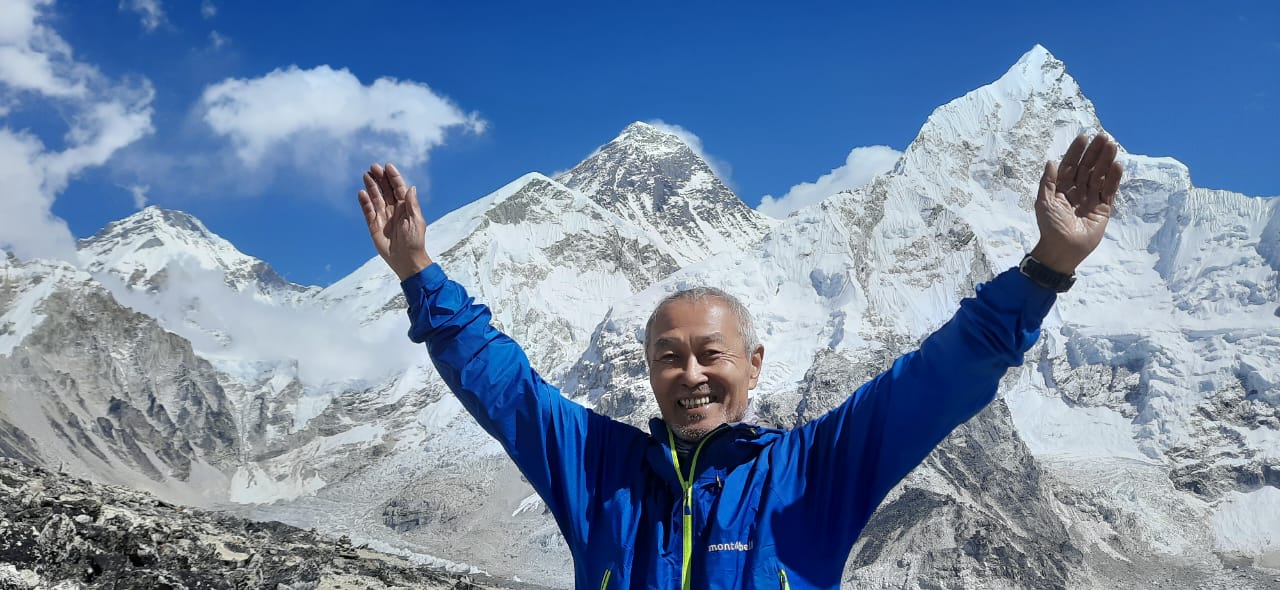
Next, the trail leads through Tengboche, Dingboche, Lobuche, and Gorak Shep before reaching Everest Base Camp. You will also hike up to Kala Patthar. This famous viewpoint offers unmatched views of Mount Everest and surrounding peaks.
Everest Base Camp Trek with Local Guides
Starting your trek in Lukla allows you to meet your crew directly in the mountains. Himalaya View Treks proudly supports local Sherpa guides and porters. By hiring local staff, we ensure you travel safely with experts who know the routes intimately.
Our local guides adjust daily schedules according to your group’s pace. Furthermore, they share rich insights about Sherpa culture, Buddhist traditions, and mountain history.
If you want to prepare properly, please read our detailed Everest Base Camp Trek Guide. A knowledgeable guide makes your trip safer, smoother, and much more enjoyable.
Trekking with a Local Company
Choosing an experienced local operator provides major advantages. Himalaya View Treks is a Nepal-based agency with full knowledge of local trails, weather conditions, and teahouses.
When you book with us, you communicate directly with the team organizing your trip. As a result, you avoid middleman fees and get accurate, real-time information.
We are based in Kathmandu, but we operate trips across Nepal. You can discover more on our page about the best trekking agency in Kathmandu.
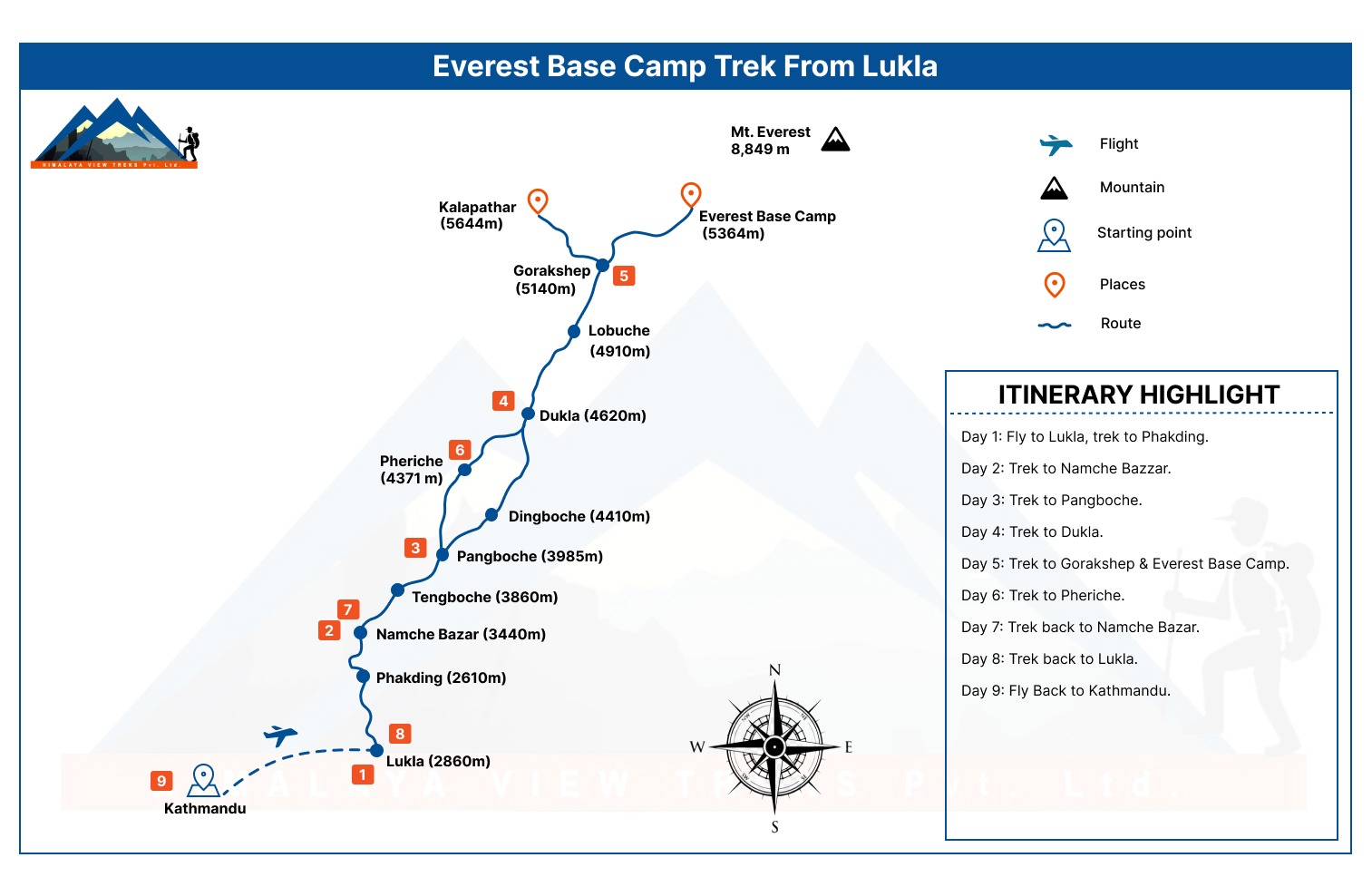
Route from Lukla to Everest Base Camp
The route follows one of Nepal’s most famous mountain trails. First, you walk along the Dudh Koshi River to Phakding.
Next, you climb toward Namche Bazaar. This section features several suspension bridges, including the famous Hillary Suspension Bridge.
From Namche, you continue to Tengboche to visit its famous monastery. Afterwards, you move to Dingboche, where the trees disappear and the landscape becomes alpine.
Finally, you pass Lobuche and Gorak Shep to reach Everest Base Camp at 5,364 meters (17,598 feet). You will also ascend Kala Patthar for clear views of Everest before descending back to Lukla.
Distance and Elevation Details
The round-trip distance between Lukla and Everest Base Camp is roughly 130 kilometers (81 miles).
The maximum altitude on this trek is 5,545 meters (18,192 feet) at Kala Patthar. Meanwhile, Everest Base Camp sits at 5,364 meters (17,598 feet).
Although the distance is manageable, the route contains steady uphill and downhill terrain. Therefore, proper pacing is important.
Sherpa Culture and Village Life
This journey is not just about mountain peaks; it is also about culture. You will walk through historic settlements like Phakding, Namche Bazaar, Tengboche, and Dingboche.
Along the trail, you will see prayer flags, mani walls, and ancient monasteries. Staying in local teahouses gives you a firsthand look at Sherpa hospitality.
Best Time to Trek
The best seasons for this trek are spring (March to May) and autumn (September to November). These months bring dry weather, clear skies, and excellent visibility.
Spring displays colorful rhododendron flowers at lower elevations. On the other hand, autumn offers crisp air and stable mountain views.
Winter is generally cold and snowy, while monsoon rains can delay flights to Lukla. Learn more on our guide for trekking to Everest in the autumn season.
Is the 8-Day Trek Right for You?
This 8-day Lukla-to-Lukla trip works best for fit travelers with limited vacation time. However, because you gain altitude quickly, it requires good physical endurance.
If you prefer a slower pace with extra rest days, consider our 12 Days Everest Base Camp Trek instead.
Why Choose Himalaya View Treks?
We combine local expertise with organized logistics to create seamless mountain adventures. Our team handles your permits, flight logistics, teahouse bookings, and safety gear.
The 8-day Everest Base Camp Trek from Lukla offers an incredible balance of adventure, culture, and high-altitude scenery in a compact schedule.
Explore More Everest Region Adventures
If you want to compare other routes, we offer several alternative trekking options in the Khumbu region Explore more in Everest Region.
Everest Base Camp Trek Guide: Read our complete Everest Base Camp Trek Guide to prepare your gear list and fitness plan.
Kala Patthar Trek: Learn more about reaching 5,545 meters on our dedicated Kala Patthar Trek page.
Gokyo Ri vs Kala Patthar Trek: Read our Gokyo Ri vs Kala Patthar comparison to choose between glacier views or direct Everest views.
12 Days Fifth Lake Trek: Explore off-the-beaten-path trails on the remote 12 Days Fifth Lake Trek.
12 Days Everest Base Camp Trek: If you want extra acclimatization days, look at our classic 12 Days Everest Base Camp Trek.
You can also check our full Everest Base Camp trek route from Lukla or review our Everest Base Camp trek cost breakdown to start planning today.
Short Itinerary
Lukla to Everest Base Camp Trek - 8 days Itinerary
Day 1: Fly to Lukla from Kathmandu, meet with guide and porter, and then trek to Namche walking distance is 13 km (9/10 Hours) 3,440m/11,283ft
Day 2: Namche Bazaar to Pangboche walking distance- of 9.1 km (5 to 6 hours) 3930m/12890ft
Day 3: Trek From Pangboche to Dukla walking distance is 7.9 km (7 hours)4,680m/15,435ft
Day 4: Dukla to Gorakshep walking distance is 6 km (6-8 hours) (Gorekshep) 5180m/16,994ft & Everest Base Camp 5364m/17598
Day 5: Hike to Kalapatthar 5,545m/18,192ft, and then trek back to Pheriche walking distance 9.8km (5-6 hours) (Pheriche4,320m/14,173ft
Day 6: Pheriche to Namche Walking Distance 14.2 km (5-6 hours) 3440m/11285ft
Day 7: Namche Bazzar to Lukla Walking Distance 13.5 km (5-6 hours) 2,800 m 9,100 ft
Day 8: Fly back to Kathmandu, Altitude of Kathmandu (1300m) (35 minutes). We woke up early for our flight back to Kathmandu.
Detailed Itinerary
Day 01: Fly to Lukla and trek to Phakding
We get ready early in the morning for our flight to Lukla (2,860 meters). We are going to set our foot on the marvelous Everest region. A short and beautiful flight lands us at Lukla Hillary airstrip where incredible mountain views welcome us to the charming mountain region. As soon as we come out of the airport, we get ready to begin the trekking journey. We are going to enter Sagarmatha national park on our trek to Namche Bazar today. As we hit the trail via Phakding, we follow the river and cross in some different places over suspension bridges. Once we check at the national park checkpoint at Monjo, we continue walking towards the destination. Although the trail today gives us the pretty tough challenge of traversing uphill trail, we go on a gentle pace to ease the challenge. Stay overnight at our teahouse. Refresh and dinner- Lukla to Namche trek distance is 13 km (9-10 Hours) 3,440m/11,283ft
Day 02: Trekking to Pangboche from Namche
You make your way to Pangboche via Namche bazaar. You then make a quick descent to Phunki Tenga and take an upward trail. The trail leading up is covered by a dense forest of pine, birch, and rhododendron.
We explore the beautiful settlement of Monjo & Jorsalle before proceeding to Pangboche. These villages display some great Sherpa culture which we learn while interacting with the local folks. Later, we follow the trail to Pangboche, the highest permanent settlement in the Khumbu. Unlike the villagers living in the higher elevations who migrate to the lower reaches during the winter season, most inhabitants of Pangboche choose to live in their village the whole year-round. Overnight bunk out in Pangboche-Namche to Pangboche walking distance- 9.1 km. (5/6 hours trek) 3930m/12890ft
Day 03: Trek to Dukla from Pangboche
After hot and warm breakfast, trekking to Dukla today so we embark on the adventure walk of the day. The trail goes amidst the high towering mountains and passes Pheriche village. We cross a mountain river along the trail to start the uphill challenge. The trail goes pretty much uphill after Pheriche up to Dukla. Overnight at our teahouse lodge, Refresh and dinner – Pangboche to Dukla walking distance is 7.9 km (7 hours)4,680m/15,435ft
Day 04: Trek to Gorakshep & hike to Everest Base Camp
We are going to trek all the way to Everest base camp today. We wake up early in the morning; take our breakfast and quickly get ready for the adventure of the day. With the excitement of reaching the Everest base camp, we set out on the trek of the day. We reach Gorakshep (5,142 meters) and stop for lunch. Gorakshep is also our overnight place for the day so we check into our lodge. Later after lunch, we get ready to trek to the Everest base camp. A gradual ascension through the boulder-strewn path takes us to the epic base camp of the highest mountain in the world. We enjoy our moments there for a while; take pictures and exploit the most out of the time. Later, we trek back to Gorakshep overnight at our teahouse lodge. Refresh and dinner- Dukla to Gorakshep walking distance is 6 km (6-8 hours) (Gorekshep) 5180m/16,994ft & Everest Base Camp 5364m/17598
Day 05: Hike to Kalapatthar & trek back to Pheriche
We have an early morning wake up today as we have to start the hike to Kalapathar before the break of dawn to reach there for sunrise. Early morning challenge of uphill hike brings us such a rewarding view that makes our day. Breathtaking panoramic view of the Mt. Everest and other mountains in the range and sunrise over those mighty peaks make this place a wonderland where we can enjoy the magical mountain marvels. Later we trek back down to our lodge in Gorakshep to have our breakfast and start trekking to Pheriche (4,371 meters) the destination for the day. After enjoying the Everest base camp and Kalapatthar moments, we are now on our return trip down towards Lukla, overnight at our teahouse lodge. Refresh and dinner – Walking distance 9.8 km (5-6 hours)5,545m/18,192ft (Kalapathar) & 4,320m/14,173ft (Pheriche)
Day 06: trek back to Namche from Pheriche
Trek back to Namche Bazar Altitude of Namche (3440m) On our trek along and among the magnificent mountains, we are trekking down to Namche today via Khumjung village. We spend some time at the small and beautiful village, Khumjung that boasts perfect views of mountains including Khumbila peak. We visit a monastery there and head towards Namche overnight at our teahouse lodge. Refresh and dinner- Pheriche to Namche Walking Distance 14.2 km (5-6 hours) 3440m/11285ft
Day 07: Trek back to Lukla from Namche
Trek back to Lukla Altitude of Lukla (2840m) Walking distance 5/6 ) We trek all the way back to Lukla today to finish the trekking journey. We trek past Monjo and Phakding villages; encounter the Dudh Koshi River along the trail and eventually reach Lukla. As the final day of the trek, we can celebrate the beautiful adventure. We see off our trekking potters here today thanking them for all the help they provided to make our trip possible, overnight at our teahouse lodge refresh and dinner- Namche to Lukla Walking Distance 13.5 km (5-6 hours) 2,800 m 9,100 ft
Day 08 fly back to Kathmandu from Lukla
Fly to Kathmandu from Lukla in the morning Altitude of Kathmandu ( 1300m) (35 minutes). We wake up early for our flight back to Kathmandu. We say goodbye to the serene and magnificent mountains and board the flight to come back to the city civilization. The rest of the afternoon in Kathmandu will be at leisure. Walking around the streets of Kathmandu; souvenir shopping; finding a massage or relaxing at the hotel can be easy ways to spend time.
Included
- Both ways Flight Ticket Kathmandu - Lukla - Kathmandu) tickets including airport taxes
- All meals (Breakfast, lunch, and dinner) during your Everest Base Camp Trek
- 8 nights Hotel Accommodation during Everest Base camp Trek
- Government licensed holder, fluent English Speaking, Familiar HVT guide from Lukla
- Assistant guide if Group sizes is more than 10 trekkers)
- Strong local Porters for Carry trekker’s luggage One porter every 2 trekkers
- Guide wages including his meals, accommodation, and Salary
- Staff insurance including medication coverage
- Water purification drop or tablets for safe drinking water
- Sagarmatha National Park entry permit fee
- Khumbu Pashang Lhamu Rural Municipality permits fees
- Seasonal fresh fruits every day during Everest Base Camp trek
- Oximeter to measure Pulse and oxygen level
- Himalaya View Treks Company T-shirt as a Souvenirs and duffel bag if you needed
- Free and safe storing at company store during the trek
- Local government, taxes, including official Service Charge
- Trip completion Certificate
Not Included
- Hotel accommodation and meals In Kathmandu
- Personal expense (shopping, snacks, boil bottle water, hot (tea, coffee) and cold drinks, hot shower, alcohol, Wi-Fi, telephone call, battery charge fee during the Everest base camp Trek)
- Personal clothing and trekking gear
- Personal travel insurance including evacuation coverage (compulsory) up to 6000m)
- Additional costs if delays flights and outside the itinerary
- All the costs and expenses which are not mentioned in includes list
- Tips for guide and porters in end of the treks
Useful Info
Trip Highlights:
- first-rate acclimatization, which gives high success rates and fulfilling enjoyment
- Trek to both Everest Base Camp and Kalapathar. The views leave you breathless
- In addition to immense rugged mountains, witness everything from still alpine lakes and glacial plains to frothy milky rivers and valleys covered in pink blossoms, depending on the season of your trip
- A trek like this gives you the great bonding experience of a lifetime and the genuine friendship formed between members of your small group will stay with you forever.
- Your first views of the mighty Himalayan range on the included flight from Kathmandu to Lukla – the famous airport in the sky, are your welcome warm-up to a great trip.
Is this your ideal trek?
Trekking in the Everest region is all about attitude. By its very nature adventure travel involves that you be prepared for the unexpected. In far-flung and developing countries do not expect the standards you are used to at home. Remote areas are sometimes unpredictable and itineraries may be altered. To enjoy your trip and get the most out of your adventure it is important that you are flexible, positive, and eager to take on all the challenges that arise from your Everest base camp odyssey. If you’re a greenhorn in the wilderness world then this trek would be ideal for you.
To truly enjoy this trip, you should be pretty habituated to walking 4-6 hours each day for several days on the go while some days will be relatively longer. We encourage you to walk at a pace that suits you without any rush whatsoever. This is a key aspect of enjoying such trips in the planet’s most popular region. You ought to be physically fit and an active walker to get the best of this classic mountainous journey to the south side of the mighty Everest.
General information important to this trip:
Difficulty levels
TREKKING AT HIGH ALTITUDES (over 3500m)
This trip includes strenuous trekking at altitudes of over 3500m. For us, altitude is a very serious issue, a result that has kept our records clean making us one of the best adventure operators in Nepal for over 30 years of operating treks in the region. Our trekking guests must be in great health and have high fitness levels to attempt this trip, as well as be committed to training to ensure you are suitably physically prepared for the tough challenges that go above 4500m.
Altitude sickness is a risk for anyone, including on the Annapurna, Langtang, and Everest Base Camp treks. Please make sure you familiarise yourself with signs and symptoms before you depart and monitor your own health during your trek, without letting it worry you.
We advise all our guests to undergo a thorough medical with their personal physician before they embark on this trip.
Participating in a group trip
When you travel with a group you will find much camaraderie and all the fun and also there’s bound to be some of the frustrations of traveling in a group. Your group mates will probably come from all corners of the world and you will come across a range of age groups too. We ask you to be understanding of the various needs and preferences of your group - patience with your fellow travelers is sometimes required for the benefit of everyone's travel experience. Remember too that you have responsibilities to the group. If you are requested to be at a place at a certain time, ensure you’re on time without keeping the rest of the group waiting. Experience has taught us often that the very best trips we operate are those where the chemistry within the group works well - this simply requires a ‘give a little take a little’ attitude effort on your part. For privacy reasons, we are unable to provide you with contact details and any personal information about your fellow travelers booked on your trip prior to departure.
TRAVELLERS who prefer going SOLO:
Our group trips are generally planned for shared accommodation and don't involve single supplements. Single travelers share with people of the same gender in accommodations ranging from twin to multi-share. Some of our itineraries have accommodation booked on a mixed-gender share basis [for couples or trekkers known to each other prior to the trip]. On a selection of our trips, you have the option to pay a single supplement to ensure that you have your own accommodation (where available). Please note that this only applies to accommodation during the trek - pre-trip and post-trip accommodation will be booked on a single-room basis at your hotel in Kathmandu. We also have arrangements for guests who wish to trek completely solo out of the group.
Travel Insurance
when booking with Himalaya View Treks, it’s a condition upon joining any of our trips that all clients must be insured for comprehensive expenses that might incur due to medical issues or accidents (this includes air ambulance, helicopter rescue, and treatment costs). Please note that we don't arrange or sell insurance because such a system is not allowed in our country.
Our Cost versus the Experience
At Himalaya View Treks, we always go the mile to ensure our trekking guests get the best experiences of the trip with maximum comfort and safety on a ratio that goes beyond the cost that we charge for the trip. We provide a ‘no frills’ price with breakdowns to make sure our clients are getting the best for a cost that goes beyond all expectations
Tipping [an expectation on such risky arduous trips]
Tipping is very much part of the culture in Nepal and although entirely at your discretion, it is usually expected. Often people would like to tip in recognition of good service but are unsure how much would be appropriate in a foreign country - for this reason, we have listed guideline amounts below (these are intended as a guideline only and you may see fit to give more or less depending on the service that you have received).
For the tipping of your trek staff and your tour leader, we suggest passing an envelope for each staff member around the group so that everyone can put in what they feel comfortable with anonymously.
The following are guideline amounts received by each staff member from the group as a whole...
- Tour Leader: Rs30,000 - 35,000 (usually tipped on the last night in Kathmandu)
- Your trekking crew (tips are usually given on the last evening of the trek in Lukla):
- Head Trekking Guide and Assistant Guides: Rs20,000 - 25,000 for each guide
- Trek Porters/yak men: Rs10, 000 for each porter or yak man
Acute Mountain Sickness [AMS]
When we ascend above 2500 meters our bodies have to acclimatize to the decreasing amount of oxygen available. So, to allow our bodies to adjust we have designed our treks in ways that help you ascend slowly, allowing acclimatization to occur when you go above the tree lines where the air is thinner. However, during the acclimatization process, you may experience some of the following symptoms.
- Headache
- Tiredness
- Disturbed sleep patterns
- Loss of appetite/nausea
- Shortness of breath
- Cough
- Palpitation
- Swelling of the hands and face
But if you feel such symptoms don’t let it worry because it’s normal. Individuals acclimatize at different rates. Some may experience symptoms, some may not. Your best strategy is to take your time and drink plenty of water. These symptoms may not indicate the onset of A.M.S. and if you experience them it does not necessarily mean that you should not continue. All our group leaders have extensive first-aid training and we urge you to communicate with the group leader at all times should you believe you have any symptoms in order that we can effectively monitor your symptoms as you go higher. The only cure for Acute Mountain Sickness is to descend. Please note, that your group leader has ultimate responsibility and may ask you to descend if symptoms persist. As a last resort, if matters grow from bad to worse, we always have a helicopter on standby for immediate evacuation.
A Typical Day on the Everest Base Camp Trek
A typical day on the trail begins with a wake-up call at around 6 AM by your guide. Freshen up and get ready. Pack your belongings and head to the dining area for breakfast by 7 AM. Check your luggage for the final time and fill your water bottle before you hit the trail by 8 AM, along with your guide.
To avoid walking in the heat and enjoy clear mountain views, you make an early start. En route, there will be short breaks to enjoy the views and take photographs. You haul up for lunch at a local teahouse around noon or mid-day. After a quick rest of about an hour or 40 minutes, you get back on the trail and continue till you reach your overnight stop.
Upon reaching the stop for the night, you head to your teahouse, check-in, and have some rest. Tea with some light refreshments (cookies or biscuits) will be served at 5 p.m. As the rooms are not insulated, you can warm yourself with the heater or stove in the communal area.
Exchange stories or play cards with other trekkers and sherpas till dinner is served (around 7 PM). After dinner, your guide will brief you about the next day’s trek – the route you will take, the difficulties, where you will stop for lunch, etc. Afterward, retire for the night and have a well-deserved rest.
On average, you may have to walk 6 to 7 hours daily. The trek to Phakding is the shortest and the easiest, while the hike to Everest Base Camp from Dukla on the 5th day could be your toughest. On Day 6, a hike to Kalapathar for the sunrise view is scheduled. So you will have to wake up before 4 AM to reach Kalapathar before sunrise. Your guide will share the details regarding the hike during the after-dinner briefing on Day 5.
Are You Already in Nepal?
If you are already in Kathmandu or Pokhara and seeking to Hire a guide/porter or tour/trekking packages, you can directly contact an expert via WhatsApp at +9779841146306. Or visit our office:- Himalaya View Treks Kaldhara Marg, Kathmandu 44600, in front of the Kathmandu Sport Climbing Center 1st-floor building.
Trip Map