Trip overview
Tsum Valley Manaslu Trek 17 Days – A Journey Through Nepal’s Hidden Himalayan Sanctuary
The Tsum Valley Manaslu Trek 17 Days combines Tsum Valley and the famous Manaslu Circuit Trek. It takes you through remote villages, old Buddhist monasteries, green forests, deep river valleys, and the high Larke Pass (5,106 m).
The Tsum Valley and Manaslu region offer a quiet trekking experience. The trails are less busy than many popular routes in Nepal. You can enjoy great mountain views and learn about local life along the way.
The region also has a strong Tibetan Buddhist culture. You will see monasteries, prayer wheels, mani walls, chortens, and prayer flags. These cultural sites add a special feel to the trek.
Nepal opened Tsum Valley to foreign trekkers in 2008. Since then, more travelers have visited this remote valley. Still, the area keeps its traditional charm. Therefore, the Tsum Valley Manaslu Trek is a great choice for trekkers who want culture, nature, and adventure.
Why Choose the Tsum Valley Manaslu Trek?
The Tsum Valley Manaslu Trek offers more than mountain views. It takes you deep into a remote part of the Himalayas. You can also learn about the local culture and way of life.
The trail passes through quiet villages and peaceful mountain paths. You can meet local people and see how they live in the high Himalayas.
You can also visit old monasteries during the trek. At the same time, the route offers views of Mt. Manaslu (8,163 m), Ganesh Himal, Himalchuli, Sringi Himal, Boudha Himal, and other peaks.
The trek combines culture and adventure. As a result, it is a good choice for travelers who want to explore Nepal beyond the busy trekking routes.
Highlights of the Tsum Valley Manaslu Trek
- Explore the peaceful Tsum Valley.
- Experience Tibetan Buddhist culture.
- Visit Mu Gompa, Rachen Gompa, and Gumba Lungdang.
- Cross Larke Pass (5,106 m).
- Enjoy views of Mt. Manaslu and other Himalayan peaks.
- Walk through rhododendron forests and alpine meadows.
- Cross suspension bridges and mountain trails.
- Explore remote villages with traditional stone houses.
- Experience a rewarding high-altitude trek in Nepal.
Where Is Tsum Valley?
Tsum Valley lies in northern Gorkha District. It sits inside the Manaslu Conservation Area near the Tibetan border.
The valley has a remote location. Because of this, local people have kept many of their old customs and traditions.
For many years, only a few travelers visited Tsum Valley. Today, more trekkers come to explore the area. However, the valley still has a peaceful and traditional feel.
The valley has high mountains, glaciers, waterfalls, forests, and alpine landscapes. Therefore, it offers both natural beauty and cultural experiences.
The name “Tsum” comes from the Tibetan word “Tsombo.” It means clear or vivid. The name reflects the valley’s natural beauty and spiritual character.
A Living Museum of Tibetan Buddhist Culture
Tsum Valley has a strong Tibetan Buddhist heritage. Local people still follow Buddhist traditions in daily life.
During the trek, you will see mani walls, chortens, prayer wheels, and colorful prayer flags. You can also visit monasteries where monks and nuns continue their religious practices.
The valley also has strong traditions of protecting living beings. Local Buddhist beliefs have traditionally restricted hunting and animal slaughter.
You will also experience warm Himalayan hospitality. Local communities welcome trekkers and share their culture and traditions.
As you walk through the valley, you can learn about local customs, language, food, and daily life.
Ancient Monasteries Along the Trail
The trek visits several important Buddhist monasteries. Each monastery offers a different cultural experience.
Mu Gompa
Mu Gompa stands near the Tibetan border. It is one of the most important monasteries in Tsum Valley.
The monastery has a peaceful setting and beautiful mountain views. It also gives trekkers a chance to learn more about Buddhist culture.
Rachen Gompa
Rachen Gompa is an important Buddhist nunnery in the region. It has traditional architecture and a peaceful setting.
You can explore the area and learn about the Buddhist traditions that shape life in Tsum Valley.
Gumba Lungdang
Gumba Lungdang sits high above the valley. It offers impressive views of Ganesh Himal and the surrounding mountains.
The quiet location also gives trekkers time to rest and enjoy the Himalayan scenery.
Join the Legendary Manaslu Circuit
After exploring Tsum Valley, the route joins the famous Manaslu Circuit Trek.
This section adds more mountain scenery and adventure. The trail passes through villages such as Namrung, Lho, Samagaun, and Samdo.
As you climb higher, the landscape changes. Green forests give way to alpine terrain. The mountains also appear closer and more impressive.
Finally, the route reaches Larke Pass (5,106 m). The crossing is challenging. However, the views make the effort worthwhile.
One of Nepal’s Best High Pass Treks
The Tsum Valley Manaslu Trek includes the famous Larke Pass. The pass stands at 5,106 meters above sea level.
From the pass, you can see Himlung Himal, Cheo Himal, Kang Guru, Annapurna II, and Mt. Manaslu.
However, the pass crossing can be demanding. High altitude, cold weather, snow, and long walking hours can make the day harder.
Therefore, good preparation is important. Proper acclimatization also helps your body adjust to the altitude. A steady walking pace is equally important.
An experienced guide can help you manage the route, weather, altitude, and daily walking plan.
Experienced Manaslu Guide for a Safe Journey
A professional Manaslu guide plays an important role during the trek.
The Manaslu region includes restricted areas. Therefore, trekkers must follow the current guide and permit rules.
Your guide can help with navigation, permits, accommodation, weather updates, and local communication. The guide can also assist if an emergency occurs.
In addition, a local guide can explain the history and culture of the region. You can learn more about the monasteries, villages, and Buddhist traditions along the trail.
Our local guides have experience in the Manaslu and Tsum Valley region. They help make your trek safe, smooth, and enjoyable.
Required Permits
The Tsum Valley Manaslu Trek requires several permits. The route passes through restricted and protected areas.
Depending on the current route and rules, permits may include:
- Manaslu Restricted Area Permit (MRAP)
- Tsum Valley Restricted Area Permit
- Manaslu Conservation Area Permit (MCAP)
- Annapurna Conservation Area Permit (ACAP), where required
- Tsum Nubri Rural Municipality permit (TNMRP), where required
Permit rules can change. Therefore, always check the latest requirements before your trek.
Our team handles the required permits and paperwork. This saves you time and lets you focus on the trek.
Best Time for the Tsum Valley Manaslu Trek
The best seasons for the Tsum Valley Manaslu Trek are spring (March to May) and autumn (September to November).
Spring brings warmer weather and blooming rhododendrons. The forests look colorful during this time. You can also enjoy good mountain views on clear days.
Autumn offers stable weather and clear skies. The monsoon has usually cleared the air by this time. As a result, the mountains often look sharp and clear.
Winter is also possible. However, snow and cold weather can make the higher sections harder. Heavy snow can also affect the Larke Pass crossing.
Therefore, spring and autumn are the best choices for most trekkers.
Why Book the Tsum Valley Manaslu Trek with Himalaya View Treks?
At Himalaya View Treks, we organize safe and well-planned Himalayan adventures. We are a government-registered trekking company based in Kathmandu, Nepal.
Our team specializes in private and small-group treks. We work with experienced local guides and porters who know the trails, villages, and mountain conditions.
When you trek with us, you can expect experienced government-licensed trekking guides, reliable porters, permit arrangements, and a clear itinerary.
We also arrange comfortable teahouse accommodation and provide support during the trek. Our team keeps the costs clear from the beginning.
Furthermore, our local guides help you understand the culture of the region. Whether you visit Mu Gompa, cross Larke Pass, or explore remote villages, we work to make your journey safe and enjoyable.
Conclusion
The Tsum Valley Manaslu Trek 17 Days combines culture, nature, and adventure. The journey takes you through the sacred Tsum Valley and the beautiful Manaslu region.
You can visit ancient monasteries, explore traditional villages, and enjoy views of the Himalayan peaks. You can also experience Tibetan Buddhist culture and local mountain life.
The trek also includes the challenging Larke Pass at 5,106 meters. This high pass adds an exciting challenge to the journey.
If you want a remote cultural experience, this trek is a strong choice. It also suits trekkers who want to explore one of Nepal’s rewarding high passes treks.
From peaceful monasteries to high mountain passes, each day brings a new experience. With an experienced Manaslu Tsum Valley guide, you can explore this special region with confidence. You can Explore Everest Region as well if you are first time in Nepal and wont to know about the roof top of the world Mt. Everest.
Short Itinerary
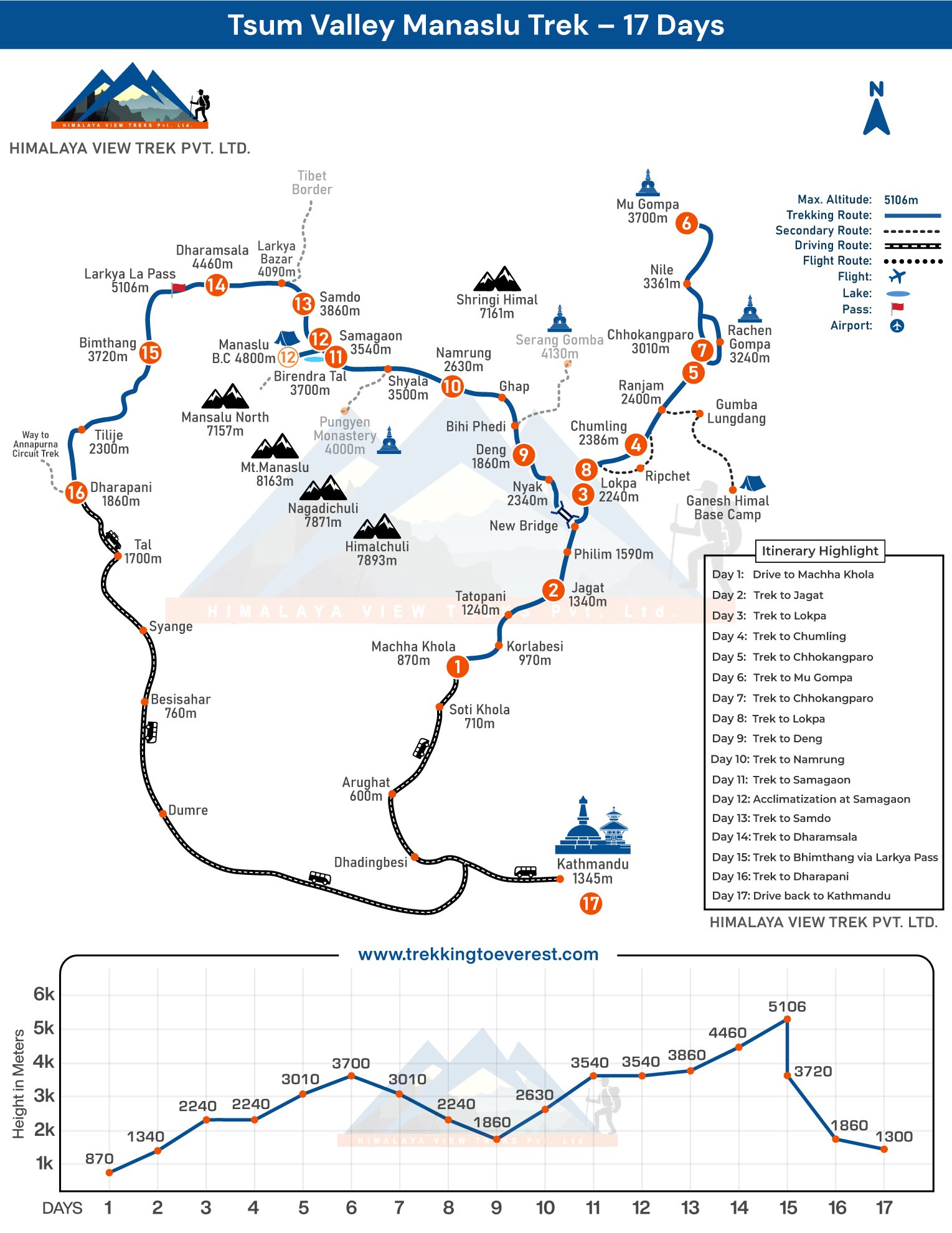
Tsum Valley Manaslu Trek – 17 Days Itinerary
Day 01: Drive from Kathmandu to Machhakhola (870m) – 7–8 Hours
Day 02: Trek from Machhakhola to Jagat (1,340m) – 6–7 Hours
Day 03: Trek from Jagat to Lokpa (2,240m) – 6–7 Hours
Day 06: Trek from Chhokangparo to Nile (3,361m) & Visit Mu Gompa (3,700m) – 6–7 Hours
Day 07: Explore Mu Gompa & Return to Chhokangparo (3,010m) – 5–6 Hours
Day 08: Trek from Chhokangparo to Lokpa (2,240m) – 6–7 Hours
Day 09: Trek from Lokpa to Deng (1,860m) – 6–7 Hours
Day 10: Trek from Deng to Namrung (2,630m) – 6 Hours
Day 11: Trek from Namrung to Samagaon (3,530m) – 6–7 Hours
Day 12: Acclimatization Day in Samagaon (3,530m)
Detailed Itinerary
Day 01: Drive from Kathmandu to Machhakhola (870m) – 7–8 Hours
Your adventure begins with a scenic drive from Kathmandu along winding roads, rivers, and rural landscapes. Reach Machhakhola, a small riverside village, and prepare for the trek ahead.
Day 02: Trek from Machhakhola to Jagat (1,340m) – 6–7 Hours
Follow the Budhi Gandaki River, crossing suspension bridges and passing through charming villages. Enter the restricted Manaslu region at Jagat.
Day 03: Trek from Jagat to Lokpa (2,240m) – 6–7 Hours
Ascend through lush forests and traditional settlements. At Lokpa, enjoy your first views toward the hidden Tsum Valley.
Day 04: Trek from Lokpa to Chumling (2,386m) – 5–6 Hours
Descend into the sacred Tsum Valley. Walk through serene landscapes and reach Chumling, a beautiful village in Lower Tsum with monasteries and mani walls.
Day 05: Trek from Chumling to Chhokangparo (3,010m) – 5–6 Hours
Climb steadily into Upper Tsum Valley. Chhokangparo offers spectacular views of Ganesh Himal and surrounding peaks, along with deep cultural experiences.
Day 06: Trek from Chhokangparo to Nile (3,361m) & Visit Mu Gompa (3,700m) – 6–7 Hours
Trek toward the Nile, the last village near the Tibetan border. Continue hiking to the sacred Mu Gompa, the largest monastery in the region.
Day 07: Explore Mu Gompa & Return to Chhokangparo (3,010m) – 5–6 Hours
Spend the morning exploring Mu Gompa and nearby monasteries, then descend back to Chhokangparo.
Day 08: Trek from Chhokangparo to Lokpa (2,240m) – 6–7 Hours
Retrace your route out of the Tsum Valley, enjoying different perspectives of the landscapes and villages.
Day 09: Trek from Lokpa to Deng (1,860m) – 6–7 Hours
Rejoin the Manaslu Circuit trail. Walk through forests and small settlements to reach Deng.
Day 10: Trek from Deng to Namrung (2,630m) – 6 Hours
Climb gradually through alpine forests and enter Nubri Valley, influenced by Tibetan culture.
Day 11: Trek from Namrung to Samagaon (3,530m) – 6–7 Hours
Enjoy stunning mountain views, including Mount Manaslu. Arrive at Samagaon, one of the largest villages in the region.
Day 12: Acclimatization Day in Samagaon (3,530m)
Take a rest day to adjust to altitude. Optional hikes include: Birendra Lake and Manaslu Base Campa
Day 13: Trek from Samagaon to Samdo (3,860m) – 3–4 Hours
A short but important acclimatization trek. Samdo is a remote Tibetan refugee village near the border.
Day 14: Trek from Samdo to Dharamsala / Larkya Phedi (4,460m) – 4–5 Hours
Gradual ascent to the base of the high pass. Prepare for the most challenging day of the trek.
Day 15: Cross Larkya La Pass (5,106m) & Trek to Bhimtang (3,720m) – 8–9 Hours
The most adventurous day! Cross the dramatic Larkya La Pass with breathtaking panoramic views, then descend to Bhimtang.
Day 16: Trek from Bhimtang to Dharapani (1,860m) – 6–7 Hours
Descend through forests and alpine meadows, eventually reaching Dharapani, where the trek concludes.
Day 17: Drive from Dharapani to Kathmandu – 8–9 Hours
Return to Kathmandu by road, marking the end of your unforgettable Himalayan adventure.
Included
- Kathmandu to Machha Khola by Local Bus, amd Dharapani to Besisahar by Local sharing Jeep and to Kathmandu by bus
- All meals (Breakfast, lunch, and dinner) during your Manaslu Circuit Tsum valley trek with 16 night Hotel Accommodation.
- Government licensed holder, fluent English Speaking, Manaslu Familiar Himalaya view Treks guide, 1 assistant guide if Group sizes is more than 10 trekkers) one guide lead up to 10 trekkers.
- Strong local Porters for Carry trekker’s luggage. One porter every 2 trekkers, Porter carry maximum 20 Kg. 10 Kg per trekkers.
- Cost Includes Guides and porters meals, accommodation, Salary, insurance, transportation, and needed equipment for the Trekking
- Water purification drop or tablets for safe drinking water.
- MCAP and ACAP permit fee
- Manaslu as well Tsum valley special trekking permit
- Seasonal fresh fruits after Dinner
- Local government, taxes, including official Service Charge
- Himalaya View treks T-shirt as a Souvenirs, and duffle bag if needed
Not Included
- Hotel accommodation In Kathmandu
- Meals in Kathmandu, before Trek as well after the Trek
- Personal expense (shopping, snacks, boil bottle water, hot (tea, coffee) and cold drinks, hot shower, alcohol, Wi-Fi, telephone call, battery charge fee during the Manaslu circuit Trek)
- Personal clothing and trekking gear
- Personal travel insurance including evacuation coverage (compulsory) up to 6000m)
- Additional costs if delays flights and outside the itinerary
- All the costs and expenses which are not mentioned in includes list
- Tips for guide and porters. in end of the treks
Useful Info
Manaslu Tsum Valley Trek Key highlights:
- Trek under the shadows of Manaslu [8,163m], the eighth-highest peak on earth
- This is a rough-cut Off-the-beaten trail, less crowded than Everest Base Camp and Annapurna Circuit. At most times hereabouts, it’s only you, the mountains, the birds & the heavens above. The animals are pretty shy in this area but you may get a glimpse of them.
- Experience diversity in culture and landscape during your Manaslu Tsum Valley Trek. Visit remote Bhotia settlements placed at high altitudes, untouched by modern civilization. Witnessing the lifestyles of the locals here is simply mind-blowing & thought-provoking.
- Walk through a historic region – the erstwhile kingdoms of Gorkha and Ghale Kings and follow an ancient trade route along the Budi Gandaki Valley
- The demanding crossover of Larkya La at (5,106m), a high mountain pass & the passing over of 3 different valleys on this trek is an unforgettable experience for a lifetime.
Are you cut out for this trip?
Manaslu trek is graded moderate, if you have done a Himalayan trek before and want to test yourself mentally, this circuit is for you. The trek lasts for 17 day. The maximum time you spend on the trail is 9 hours to a minimum of 3 hours. On average, you spend around 5 to 6 hours on the trail.
The route winds across a challenging terrain (Cliffside gravel paths and stone staircases). Certainly Not for greenhorns. Each day there will be an elevation gain of 300 to 500 meters. The trail is less crowded and filled with awesome mountain views. You must be a habituated hiker & mentally strong for a trip of this kind.
The highest point reached during your trek is Larkya La at 5,106m, a high mountain pass that connects Budi Gandaki Valley with Marshyangdi Valley. You stop at local mountain lodges or teahouses for food and accommodation. These teahouses offer basic lodging and meals.
Best Time to Trek in part of the Manaslu and Tsum valley
Spring (March to May) and autumn (mid-September to November) are considered the best seasons for Manaslu Trek. The weather stays dry and clear during these times, making it ideal for trekking and enjoying unobstructed views of mountains. The days are warm and the nights chilly. On the downside, however, these are peak seasons, and the trails may get crowded and busy.
The trail to Manaslu passes through a pristine forest that is filled with wildflowers and orchids during spring. Walking past the hills covered with wildflowers against the backdrop of the snowy Himalayas will seem heavenly. Autumn is the most popular season for Manaslu Trek.
With the end of the wet monsoon season, which clears the skies of dust and impurities, you can enjoy crystal clear views during this season. Timing your trek around late September or October will allow you to experience the most important festivals of Nepalese, Dashain, and Tihar.
These festivals are celebrated by the Ghales, Gurungs, and Brahmins living in the lower reaches of the trail. If you are bold enough to brave a cold winter trek, you can time your trek during January or February, when the Buddhist communities celebrate Losar or Tibetan New Year in the high mountains.
An important festival celebrated in the Nubri Valley is the Dhachyang or the Horse Festival. This festival which falls during December or J+
Entry Permits & Requirements
Since solo trekking or FIT (fully independent travel) is barred in this region, the permits will be arranged by the agency with whom you book your trek. There should be at least two people in your group to obtain the Manaslu Restricted Area Permit.
The permits needed for Manaslu Trek are:
Manaslu Conservation Area Project Entry Permit,
Annapurna Conservation Area Project Entry Permit,
Manaslu and Tsum Valley, two Restricted Area Permit, and
Except for the Manaslu Restricted Area Permit, which has to be obtained from the Department of Immigration, all these permits can be acquired from the Nepal Tourism Board’s Office in Kathmandu and Pokhara.
To get these permits, you need to provide the following documents and information:
Original and copies of your passport
Passport-sized photos
Entry and exit points
Emergency Contact Information (local and home country)
Travel Insurance Details
Manaslu Trekking Permit Fees:
Manaslu Conservation Area Project (ACAP) Entry Permit: NRS 3000 per person for foreigners, NRS 1000 for citizens of SAARC countries, and NRS 100 for Nepalese.
Annapurna Conservation Area Project (ACAP) Entry Permit: NRS 3000 per person for foreigners, NRS 1000 for citizens of SAARC countries, and NRS 100 for Nepalese.
Tsum valley Trekking Permit (Trekking permit of Tsum Valley)
From September to November US$35 for the first 8 days
From December to August US$25 for the first 8 days
Manaslu Restricted Area Permit : (a) From September to November – USD 100 per person for 7 days and USD 15 per person per day after the 7th day (b) From December to August – USD 75 per person for 7 days and USD 10 per person per day after the 7th day.
Altitude Sickness & Acclimatization
Manaslu Trek takes you to the base of the 8th highest mountain in the world, Manaslu (8,156m). The highest point of your trek is the mountain pass of Larkya La (5,106m). In this environment, there is less oxygen which will lead to breathing difficulty.
To let your body get used to the thin air, you need to walk slowly, and steadily and keep your body hydrated. If you try to hasten and walk fast to reach your destination in less time, chances are you may suffer from AMS or Acute Mountain Sickness.
AMS symptoms like dizziness, headache, nausea, shortness of breath, fatigue, etc., are seen at elevations above 2000 meters. Taking Diamox and a good night’s rest may work for mild cases. Drinking plenty of fluids (water, tea, soup, etc.) and keeping your body hydrated will also help to keep the sickness at bay.
One should take necessary precautions to ensure that the condition does not worsen. But if the symptoms worsen, one may have to return to a lower elevation and get medical help. In the worst-case scenario, an air evacuation will be arranged, where the patient will be flown to Kathmandu to receive medical aid. AMS, if untreated or ignored, can take your life.
Experts and veteran guides have designed this itinerary. A rest day in Sama Gaon has been included in the itinerary to allow your body to adapt to the thin mountain air. The trek is well-paced and allows your body to gradually get used to low oxygen levels in the mountain air.
Drinking Water
It is important to keep your body hydrated on the trail as dehydration also causes AMS. One should drink at least 3-4 liters of fluid.
Though bottled water is readily available at teahouses, we dissuade you from buying it as it adds up to the thrashing problem in the mountains. Moreover, like everything else, bottled water is also expensive in the mountains.
We highly recommend you carry a reusable water bottle with you, one that can hold hot water. You can use one with a sterile pen or an inbuilt filtration system like LifeStraw.
You can also use water purification tablets to treat the water. You might feel the water in the mountains tends to be pure and without impurities, but it's better not to take chances and filter or treat the water before drinking.
Using chlorine or iodine tablets to treat the water may alter its taste. You can add flavored electrolyte powder (readily available at pharmacies in Kathmandu) to mask the bitter chemical taste. Adding electrolyte to your drinking water may also be beneficial as the minerals (sodium, potassium, magnesium, etc.) you lose while walking gets replenished.
Teahouses offer boiled and filtered drinking water at an additional cost. Like bottled drinking water, it can cost anywhere between 1 USD to 4 USD. Charges vary according to altitude (the higher you reach, the more expensive it gets) and quantity also matters.
Internet Connectivity
Internet connection (though erratic and irregular in some places) is available in the Manaslu Region. You can connect with your loved ones while trekking, post updates, and upload pictures on social media. Wi-fi is available at most of the teahouses. Teahouses charge extra for using their Wi-Fi hotspot. Everest Link, a local internet provider, offers paid internet access on the trail. You can purchase the username and password at any of the teahouses or shops along the trail. You can also get a mobile sim card in Kathmandu and use it to keep in touch with your family and friends.
Packing Checklist for Manaslu Larkya Pass Trek
As opposed to popular belief, you don’t need any complicated gear and equipment for this adventure. Here’s a basic checklist of the essential items that you should not forget to bring with you during your Manaslu Trek:
A sturdy pair of trekking boots with good ankle support
Rucksack or daypack (30 liters) with waterproof cover
Trekking pants and waterproof trousers
T-shirts or shirts
Down jacket
Wind/ waterproof light jacket
Fleece jumper or jacket
Inner Thermal (top and trousers)
Socks and underwear
Sunglasses, sun hat, woolen cap, or balaclava
Inner and outer gloves
Headlamp, power bank, and extra batteries
Sun protection cream, wet wipes, and hand sanitizer
Towel, flip-flop or rubber sandal, toiletries
Water bottles and water purification tablets
Crampons and Gaiters
4 season Sleeping bag
Sleeping bag liner
These are only some of the essential items. Find a more detailed Packing List for Trekking in Nepal on our website.
Most of the trekking equipment is available for hire in Kathmandu. You can keep your baggage light by only packing the essential items and renting or buying the rest in Kathmandu. Shops in Thamel offer branded as well as locally made gear and equipment.
You can leave your spare luggage in your hotel’s storage room. It is completely safe and free. But do make sure to lock your luggage before leaving it at the storage unit.
Guide(S) & Staff Arrangements
Manaslu Trek takes you to the foot of the 8th highest peak in the world, Manaslu (8,156m). En route, you will be crossing a mountain pass, glacier, and bridges over turbulent Himalayan Rivers. Having an experienced local guide accompanying you will enrich your trip in so many ways. Trekking with a person who has in-depth knowledge of the mountain will also keep you safe and secure.
When you book a trek with us, we pair you up with one of our local guides. All our guides have experience of more than a decade and have a vast knowledge of the area you are visiting. They have completed the trekking guide course and have the required government license to work as mountain guides. They can communicate in English and have received training in wilderness first aid and crisis management.
A chief guide or trek leader will lead the trek. For every 4 trekkers, there will be an assistant guide assisting them personally. One porter will carry the luggage of 2 clients. Make sure that your luggage does not exceed 15 kg, as the porter can only carry a weight of 30 kg.
We believe in the ethical treatment of our staff. All our Guides and Porters are provided with weather-appropriate gear and clothing to battle the harsh weather in the mountains. Before the start of a trek, we ensure that our mountain guides are fully insured. They are given fair wages and treated with respect.
We seriously follow the guidelines set by IPPG (International Porter Protection Group) and offer assistance to porters to develop other skills. A portion of the booking fee goes to fund the education of our field staff’s kids.
Travel Insurance
For Manaslu Trek, you need a good travel insurance policy that offers you coverage for all activities and altitudes included in your itinerary. The highest altitude you reach is 5,106 meters, and your travel insurance should offer you suitable coverage up to this elevation.
Though we take your safety as our number one priority, we cannot rule out mishaps and emergencies that may occur at this altitude.
There is less oxygen in the environment, and trekkers usually suffer from Acute Mountain Sickness, which could prove to be fatal if not treated on time.
Walking in a treacherous mountain environment also exposes you to physical injuries. Therefore make sure that your insurance covers the cost of all injuries and emergencies that you can face during this trekking adventure. Nature can be a monster when least expected.
Your insurance policy should especially cover the cost of helicopter evacuation and hospitalization in case of an accident or medical emergency, as these happen to be quite expensive. Check for vaccination requirements as some travel insurance policies makes it mandatory to immunize yourself before you leave your country.
Before you decide on a policy, be mindful and don’t forget to read the fine print. It would be advantageous for you also to choose a company that offers insurance coverage on domestic and international flight cancellations and lost or stolen baggage.
Trip Safety
We ensure the safety of our clients by following all safety protocols during the trip. This itinerary has been designed by travel experts and veteran guides who have trekked on this route innumerable times. To prevent AMS, the required number of rest days has been added to the itinerary. Our guides always carry a first-aid kit and pulse oximeter (to measure the oxygen level in your blood) with them. The guides assigned to you have more than 10 years of experience and know what steps to take during an emergency. They are well-trained in wilderness first aid and crisis management.
If a client shows symptoms of AMS and needs to descend to a lower elevation, an assistant guide will escort them and follow the safety protocol. He will closely monitor the client’s condition and take the required steps needed for the client's well-being. If they feel alright after a night’s rest, the guide will escort the client back to join the group. But if the condition worsens, the client will be escorted down to a lower elevation or airlifted to Kathmandu for expert medical aid.
A Typical Day on the Manaslu Tsum Valley Trek
A typical day on the trail begins with a wake-up call at around 6 AM by your guide. Freshen up and get ready. Pack your belongings and head to the dining area for breakfast by 7 AM. Check your luggage for the final time and fill your water bottle before you hit the trail by 8 AM, along with your guide.
To avoid walking in the heat and enjoy clear mountain views, you make an early start. En route, there will be short breaks to enjoy the views and take photographs. You stop for lunch at a local teahouse around noon or mid-day. After a quick rest of about an hour or 40 minutes, you get back on the trail and continue till you reach your overnight stop. Upon reaching the stop for the night, you head to your teahouse, check-in, and have some rest. Tea with some light refreshments (cookies or roasted corn) will be served at 5 PM. As the rooms are not insulated, you can warm yourself with the heater or stove in the communal area. Exchange stories or play cards with other trekkers & your crew till dinner is served (around 7 PM). After dinner, your guide will brief you about the next day’s trek – the route you will take, the difficulty, where you will stop for lunch, etc. Afterward, retire for the night and have a well-deserved rest.
On average, you may have to walk 5 to 6 hours daily. The toughest day will be the crossing of Larkya La on Day 15. There will be plenty of stops on route to take pictures and enjoy the scenery.
Responsible Travel
We always expect our respected guests to travel responsibly and do their best to limit any negative impact on the environment. Limit the use of plastic and be mindful about throwing waste in the mountains. When you trek with us, you will be supporting local communities (from the guides and porters to teahouse owners). We, as a registered company with the government, support sustainable tourism and patronize local businesses. We partner with service providers who work towards saving the environment. We’re aware that devoted practice is more necessary than simply preaching when it comes to Responsible Travel.
Trip Map