Trip overview
Manaslu Expeditions Cost and Itinerary 2027
Mount Manaslu stands proudly as the eighth-tallest mountain in the world at 8,163 meters (26,781 feet). Known locally as Kutang, the “Mountain of the Spirit,” this magnificent peak in the Mansiri Himalayan range offers an unforgettable high-altitude mountaineering experience. Manaslu Expeditions attract climbers from all over the world seeking a challenging but rewarding ascent. Consequently, scaling Mt. Manaslu provides an ideal milestone for mountaineers who aim to climb Everest or other 8,000-meter giants.
Because many Western mountaineers are still discovering this incredible peak, Manaslu offers raw, pristine, and uncrowded alpine wilderness. Furthermore, ascending this towering 8,000-meter peak adds an extraordinary triumph to your travel tales. However, climbers must never underestimate the physical demands and technical preparation required for a successful high-altitude ascent. At Himalaya View Treks, our veteran Sherpa climbing guides bring over two decades of mountaineering expertise to ensure safety, comfort, and success on the slopes of Mt. Manaslu.
Why Choose the Autumn Season for Manaslu Climbing?
While spring serves as the primary season for Mt. Everest expeditions, autumn stands out as the optimal window for climbing Mt. Manaslu. The ideal climbing season spans from early September through late October.
During early autumn, stable weather patterns, crisp air, and crystal-clear mountain views dominate the region. Furthermore, post-monsoon snow conditions provide optimal coverage over ice formations and technical crevasses, which creates safer footing along the climbing routes. Booking your Manaslu expedition for the 2027/2028 autumn season gives you access to ideal climbing conditions alongside our expert expedition crew.
Route Overview & High-Altitude Acclimatization Strategy
Our 41-day expedition incorporates a strategic route along the famous Manaslu Circuit Trek corridor. However, we take a unique, harder reverse route. Rather than taking the standard trail, we trek in reverse from Dharapani through Bimthang and across the formidable Larkya La Pass (5,215m) before descending into Sama Gaon.
This harder reverse route serves two critical purposes:
Superior Acclimatization: Traversing high alpine terrain early prepares your body naturally for extreme altitude before you arrive at Base Camp.
Physical Conditioning: Daily trekking through rugged valleys builds endurance and mental fortitude for the climbing phase ahead.
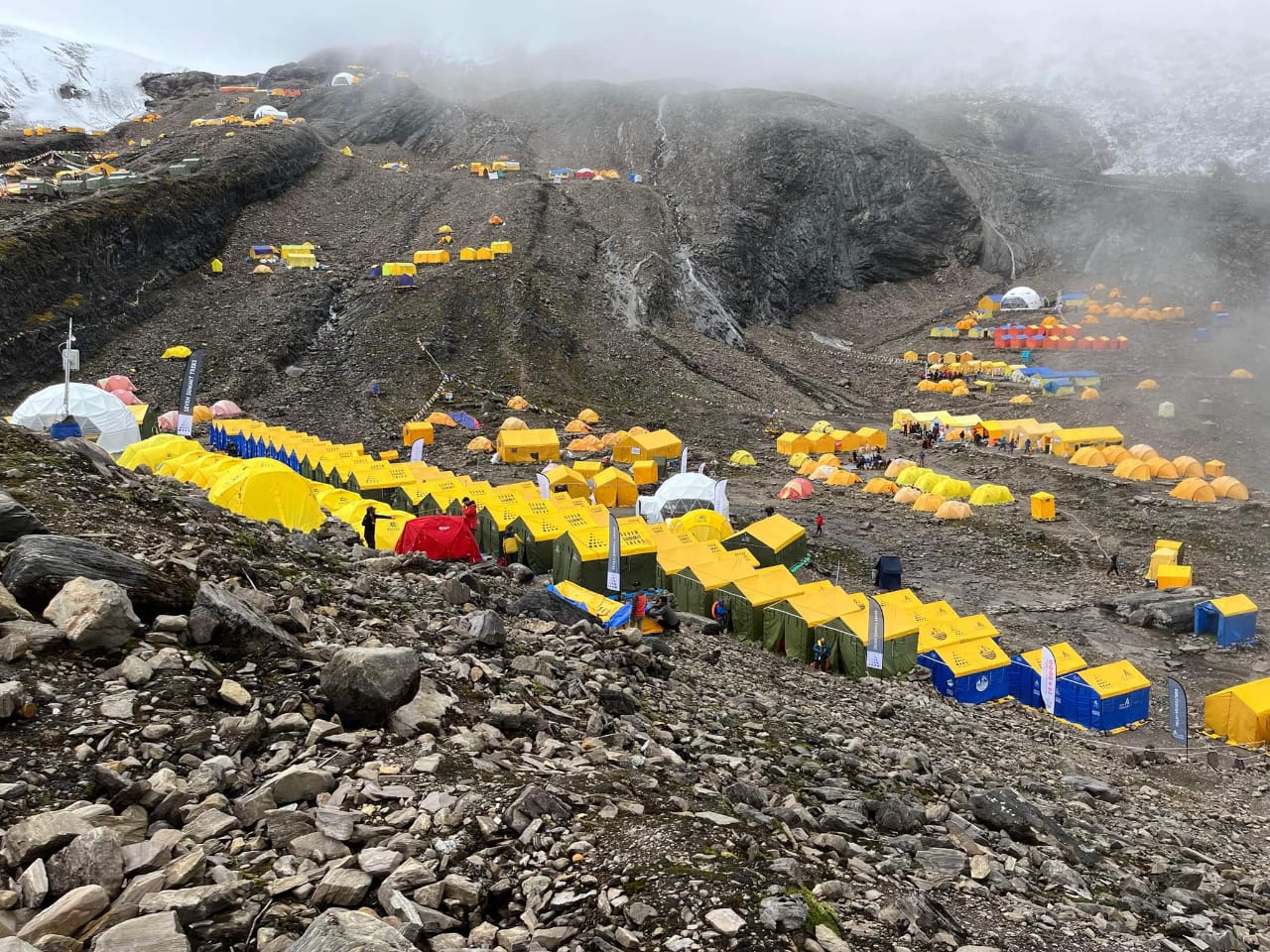
Climbers begin the journey with a drive from Kathmandu to Besisahar, followed by an off-road trip to Dharapani. From Dharapani, we trek through picturesque Gurung and Tibetan-style villages, including Tilje, Bimthang, Samdo, and Sama Gaon. Up until Sama Gaon, climbers enjoy full teahouse hospitality led by an expert trekking and climbing guide. Once we arrive at Manaslu Base Camp (4,700m), we transition into full tented camp operations.
Related Peak Climbing & Acclimatization Objectives
If you are looking for introductory 6,000-meter peak training before taking on an 8,000-meter giant like Manaslu, the Manaslu region and neighboring areas offer several outstanding climbing options:
Larkya Peak Climbing (6,249m): Located directly adjacent to the Larkya La Pass along the Manaslu with Annapurna Circuit Trek route, Larkya Peak is an ideal 6,000m trekking peak for practicing glacier travel, crampon techniques, and fixed-rope management.
Himlung Himal Expedition (7,126m): Situated near the Manaslu range in the remote Peri Himal region near the Tibetan border, Himlung Himal serves as an excellent intermediate peak between 6,000m climbing peaks and 8,000m expeditions.
Surrounding Mardi Himal Trek: A shorter, highly scenic trail in the Annapurna region that offers quick ridge walks and breathtaking views of Machhapuchhre (Fishtail) and Annapurna South.
Island Peak Climbing with EBC (6,189m): Located in the Everest region, Island Peak offers ideal technical preparation for aspiring Himalayan mountaineers.
Everest Three Passes Trek: A challenging trek across Kongma La, Cho La, and Renjo La passes in the Everest region, providing superior high-altitude endurance training.
The Summit Route: Camps and Mountain Technicality
Climbers negotiate the Northeast Face, which features four distinct high-altitude camps above Base Camp:
Base Camp (4,700m) to Camp I (5,700m): The lower section crosses moderate snow slopes and moraines. This stretch allows climbers to establish a steady rhythm while adjusting to high-altitude gear.
Camp I (5,700m) to Camp II (6,400m): The terrain steepens significantly above Camp I. Climbers encounter the most technical section of the mountain, navigating ice bulges, short ice walls, and crevasses using fixed ropes and ascenders.
Camp II (6,400m) to Camp III (6,800m): This section ascends through snow slopes and wide plateaus. Although less technical than the lower icefall, high winds and thinning oxygen demand steady endurance.
Camp III (6,800m) to Camp IV (7,400m): Located on a high flat col, Camp IV serves as the final launching pad for the summit push.
Summit Push (8,163m): Climbers push through steep snow slopes, narrow icy ridges, and the final technical summit crest to reach the true summit. Standing on the top rewards you with uninterrupted, breathtaking panoramas across the entire Nepalese and Tibetan Himalayas.
Manaslu Expeditions Cost Breakdown (2027 / 2028)
At Himalaya View Treks, we offer structured group pricing so that larger groups benefit from significantly reduced rates.
Solo Climber (1 Pax): $13,500 per person
Group of 2 Paxes: $13,300 per person
Group of 3–4 Paxes: $13,100 per person
Group of 5–8 Paxes: $12,900 per person
Group of 9+ Paxes: $12,500 per person
What the Cost Includes:
All airport transfers in Kathmandu via private vehicles.
4 nights of hotel accommodation in Kathmandu on a Bed & Breakfast (BB) basis.
Overland transportation (Kathmandu – Besisahar – Dharapani & Arughat – Kathmandu).
Official Government Liaison Officer fees, insurance, and equipment.
Annapurna Conservation Area Project (ACAP) and Manaslu Conservation Area Project (MCAP) entry permits, plus restricted region permits.
High-altitude Sherpa climbing guides, camp cooks, and kitchen staff.
Full teahouse and tented camp meals throughout the trek and expedition.
High-altitude climbing gear, fixed ropes, group climbing equipment, and camp logistics.
Book Your Manaslu Expedition with Himalaya View Treks
Planning an 8,000-meter peak climbing expedition demands absolute trust in your local agency. Led by senior climbing experts like Kamsinge Tamang—who brings 10 successful Everest summits and 3 Manaslu ascents—our team ensures safety, personalized care, and unmatched mountain support. Whether you choose to trek the classic Manaslu Circuit Trek or climb Mt. Manaslu, we are here to turn your Himalayan dreams into reality.
Short Itinerary
Manaslu Expeditions Itinerary
01 Sep: Day 01: Arrival at Kathmandu Airport and Hotel transfer.
02 Sep: Day 02: Preparation, Briefings, Last minute shopping and formalities.
03 Sep: Day 03: Drive from Kathmandu to Besisahar (950m-6 Hrs.), lodge.
04 Sep: Day 04: Drive to Dharapani (1300m-5 Hrs.); lodge.
05 Sep: Day 05: Trek to Tilje (2300m-6 Hrs.); Lodge.
06 Sep: Day 06: Trek to Bhimtang (3590m-6 Hrs.); lodge.
07 Sep: Day 07: Rest & Acclimatization Day in Bhimtang, lodge.
08 Sep: Day 08: Cross Larkya La (5215m) and trek to Shamdo (3875m-10 Hrs.), lodge
09 Sep: Day 09: Trek to Sama Gaon (3780m-3 Hrs.), lodge.
10 Sep: Day 10: Trek to Manaslu Base Camp (4700m-4 Hrs.), set camping.
11 Sep-02 Oct: Day 11-32: Climbing period; summit Manaslu (8163m), full camping.
03 Oct: Day 33: Preparation for return to Kathmandu; Clean Base Camp.
04 Oct: Day 34: Trek back to Sama Gaon, lodge.
05 Oct: Day 35: Trek to Namrung (2550m-5 Hrs.), lodge.
06 Oct: Day 36: Trek to Philim village (2300m-6 Hrs.), lodge.
07 Oct: Day 37: Trek to Machha Khola (1330m), lodge.
08 Oct: Day 38: Trek to Soti Khola Drive to Arughat (950m), lodge.
09 Oct: Day 39: Drive to Kathmandu, 7 hours; hotel accommodation (BB Plan).
10 Oct: Day 40: D-Briefing, rest and contingency day, farewell dinner in Kathmandu.
11 Oct: Day 41: Transfer to the airport for final departure.
Included
- All arrival and departure transfers in Kathmandu.
- 4 nights of hotel accommodations in Kathmandu on BB Plan.
- Kathmandu-Besishahar-Dharapani/Arughat- Kathmandu land transfers.
- Mt. Manaslu expedition permit (Royalty; US$ 900 for member).
- Government official Liaison Officer for Mt. Manaslu Expedition.
- Annapurna and Manaslu Conservation Area entry permits
- Special/Restricted Manaslu area trekking and TIMs card for members.
- All camping equipment in Advance Base Camp and other camps.
- Food, accommodation and guide during trekking in teahouse/lodge.
- Food during the expedition period, cooked by our experienced cook at BC.
- 1:1 experienced private climbing Sherpa guide for climbing support.
- 2 Oxygen (4 Ltrs.) bottles for climbing members and 1 for Sherpa.
- Mask & regulators 1-set for climbing member and Sherpa.
- Gamow bag at BC for emergency rescue purposes.
- Solar panels for light and battery charging in base camp.
- Icefall and rope fixing charges, tents at high camps C1, C2, and C3.
- First Aid medical kits for the Group and the staff.Walkie-talkies & satellite phone for communication (uses charge $ 5 per unit for Sat).
- Office service charges and government taxes levied in Nepal.
- Farewell Dinner
Not Included
- Lunch and Dinner during your stay in Kathmandu (except farewell dinner).
- Laundry, communication expenses and Internet uses.
- Clothing, packing items or bags, personal medical kit, camera/video fees and trekking gears.
- Any extra expenses arising out of various/unforeseen situations like natural calamities, landslides, political disturbances, strikes, changes in Government regulations, etc.
- Any additional staff other than specified.
- Rescue, repatriation, medicines, medical tests and hospitalization expenses for members.
- Summit bonus to your private Sherpa guide if approached to the summit (Minimum US$ 1000.00)
- Tips to Base Camp Staff (Mandatory minimum US$ 200.00 per Member in Total)
- Medical and Travel Insurance with helicopter search and rescue for members.
- Permits for walkie-talkies & filming if special camera.
- Defined personal climbing gears.
- Tips, gifts, souvenirs.
Useful Info
Lead Mountaineering Guide
Kamsinge Tamang: Senior High-Altitude Expedition Leader
With 10 successful Mt. Everest summits and 3 Mt. Manaslu ascents, Kamsinge Tamang leads our mountaineering teams with unmatched expertise, safety protocols, and deep local knowledge of the Himalayas.
Essential Expedition Information
1. Best Season for Manaslu Expedition
Autumn (September to October): Offers stable post-monsoon weather, clear mountain skies, and optimal snow coverage over crevasses and technical ice bulges.
2. Fitness & Technical Skills Required
Climbers should have previous high-altitude experience (preferably on 6,000m+ peaks like Island Peak or Mera Peak).
Proficiency with crampons, ascenders (Jumar), fixed ropes, and ice axes is required.
3. Equipment & Climbing Gear
Personal Gear: High-altitude down suit (-30°C to -40°C rated), double or triple mountaineering boots, glacier sunglasses, microspikes, harness, and carabiners.
Group Gear: High-altitude tentage, oxygen bottles (if required), satellite phones, solar charging panels, and fixed ropes are provided by Himalaya View Treks.
4. Permits & Liaison Officer
All necessary restricted area permits (MCAP, ACAP) and official Nepal Government Liaison Officer fees are fully covered and arranged by our team prior to departure.
5. Medical & Emergency Evacuation
Comprehensive high-altitude travel and medical insurance covering emergency helicopter evacuation up to 7,000m+ is mandatory for all climbers.
FAQs
-
How difficult is Manaslu Climbing Expedition?
Climbing an 8000 meter mountain is not easy adventure. It is a difficult task. However, it depends upon the physical condition of the climbers. Difficulties faced during the expedition are AMS, body endurance, weather and climate conditions, climbing gears, and preferred climbing route.
-
Is it necessary to have Climbing Insurance?
Yes, it is mandatory for the climbers to take the climbing insurance. In fact, it is the first thing on the requirements to be fulfilled for the climbing. The insurance covers the trekking portion as well. The plan has to cover for the emergency situations like accidents, delays, cancellations, helicopter rescue, and medical expenses.
-
Can I climb Solo?
Absolutely not! You are not allowed to do trekking also as a solo. Nepal Government doesn’t allow solo travelers to the Manaslu Region. You must be in at least group of two travelers. Authentic Nepal Government licensed company is needed for all the formalities.
-
Do my climbing members get fully equipped and insured?
Yes, all of our climbing members are fully equipped and insured. They have more than a decade of experience in the field of climbing expeditions in Nepal. Most of them are Everest Summiteers as well.
-
What kind of physical condition is needed for the climbing?
You need to be in the best physical condition. Perform regular exercises outdoor which improves breathing and cardio before stepping for the climbing. You can get the mountaineering training as well. The best way to do the Manaslu Climbing is by climbing some of the smaller peaks. For example, you can do the peak climbing of Island Peak, Lobuche Peak, Mera Peak etc.
Latest Traveller's Reviews
Travel experiences of our clients who recently returned from their trips.