Trip overview
Manaslu and Annapurna Two Passes Trek – A Long Himalayan Adventure
The Manaslu Annapurna Circuit Trek provides an ambitious, rewarding Himalayan adventure. First, this route combines two of Nepal’s most famous trekking regions into one unforgettable journey. During this 19-day trip, you hike through remote mountain landscapes, traditional villages, ancient monasteries, lush forests, alpine valleys, and high-altitude terrain.
This trail suits experienced trekkers perfectly. Specifically, it offers the ultimate route for travelers who want to explore both the Manaslu Circuit and Annapurna Circuit at once. Along the way, you cross two high passes: Larkya La Pass at 5,106 meters and Thorong La Pass at 5,416 meters. In addition, you enjoy incredible views of the surrounding Himalayan peaks throughout your walk.
Here is an overview of what you can expect on a Manaslu-Annapurna Circuit combined trek.
Manaslu and Annapurna Two High Passes Trek – Larkya La and Thorong La
The Manaslu and Annapurna Two Passes Trek blends remote mountain paths with well-established trekking routes. Throughout this 19-day trek, you experience two distinct regions while crossing two high-altitude passes.
Diverse Landscapes: First, your trek begins in lower Manaslu, where lush forests, terraced fields, and rivers fill the landscape. As you hike higher, the scenery transforms into alpine meadows, glacial valleys, and rocky mountain peaks.
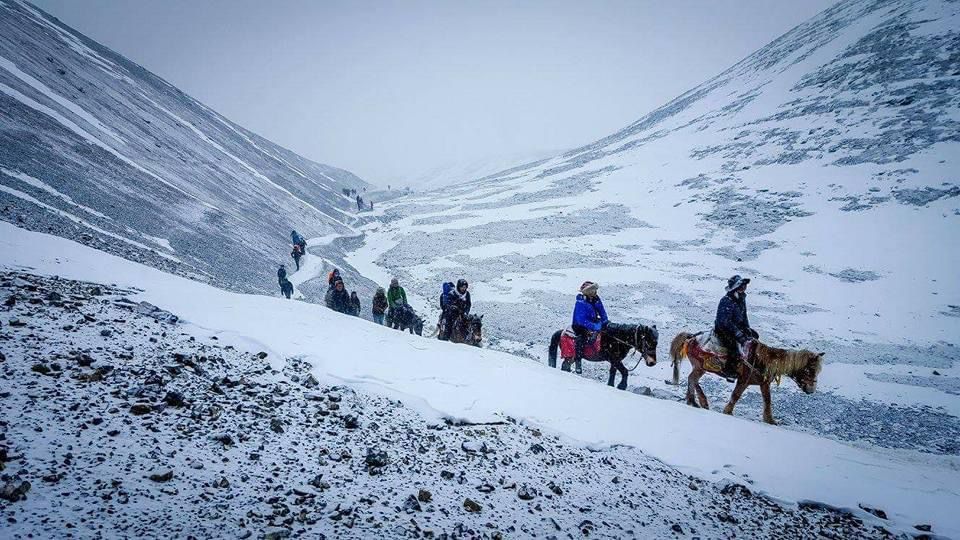
Two High Passes: Crossing Larkya La Pass at 5,106 meters in Manaslu stands out as a top highlight. Later, your trail meets the Annapurna Circuit and crosses Thorong La Pass at 5,416 meters. However, both pass crossings require careful preparation, proper acclimatization, and good weather.
Culture and Mountain Communities
The Manaslu Circuit trek with Annapurna Circuit offers a rich cultural experience. In the Manaslu region, you discover Tibetan-influenced villages, Buddhist monasteries, spinning prayer wheels, stone chortens, and welcoming mountain communities.
As you hike toward the Annapurna region, you experience a unique mixture of Hindu and Buddhist traditions. Along the trail, ancient temples, traditional homes, and mountain shrines highlight the rich cultural diversity of Nepal.
In general, the Manaslu Circuit offers a quieter, more remote environment during your first week. However, once you enter the Annapurna Circuit, you find busier trails, larger villages, and frequent teahouses along the route.
Landscapes of Manaslu and Annapurna
The combined route offers an incredible variety of changing scenery throughout your journey. First, the lower Manaslu section leads you through deep river valleys, dense forests, rushing waterfalls, and remote mountain villages.
As you ascend into the higher Manaslu region, alpine landscapes take over. Here, you enjoy dramatic views of Mount Manaslu and its neighboring peaks. After crossing Larkya La Pass, the trail enters the Annapurna region, where the environment shifts once again.
Next, the Annapurna Circuit delivers a stark visual contrast as lush green valleys give way to dry, high-altitude terrain. Finally, trekking around the Annapurna massif rewards you with endless Himalayan views and a chance to explore Nepal’s dramatic rain-shadow landscape.
Tilicho Lake Extension
You can easily add a trip to Tilicho Lake if you want to explore another spectacular spot in the Annapurna region. Sitting at 4,919 meters, this body of water is one of the highest lakes in the world. High mountain peaks surround the shore, creating unforgettable landscape views.
The Tilicho Lake Trek offers an exciting side detour from the main route. First, you hike through dramatic terrain. Then, you arrive at the bright turquoise waters of the lake itself. Ultimately, adding this side trip makes your Himalayan journey even more rewarding.
Permits and Regulations for the Manaslu and Annapurna Circuit Trek
Because this route passes through protected areas, you must secure official permits before starting your journey.
Restricted Area Permit: You need a special permit to enter the restricted Manaslu region, and local laws require you to hike with a licensed guide in this area.
Manaslu Conservation Area Permit (MCAP): You must purchase this entry pass to travel through the Manaslu Conservation Area.
Annapurna Conservation Area Permit (ACAP): You also need this official pass to enter and hike through the Annapurna region.
Fortunately, our team handles all permit paperwork and route logistics so you can prepare for your trip stress-free.
Difficulty and Preparation
The Manaslu and Annapurna Circuit Trek presents a demanding long-distance challenge. High altitudes, remote trails, long walking days, and two steep pass crossings require strong fitness and trekking experience.
Because you cross two high passes above 5,000 meters, proper acclimatization is essential. Therefore, you should train with regular hiking, cardio workouts, and strength training before arriving in Nepal.
You must hire a guide for the Manaslu section, and we strongly recommend keeping your guide for the entire route. An experienced guide helps with navigation, books tea houses, manages permits, and monitors changing weather conditions.
Finally, prepare well for the high altitude before you tackle Thorong La Pass Trek Difficulty, as this early morning crossing requires great stamina.
Best Time for the Manaslu and Annapurna Two Passes Trek
The spring (March to May) and autumn (September to November) months offer the best seasons for the Manaslu and Annapurna Circuit Two Passes Trek. During these months, you experience stable weather and optimal trail conditions.
Spring (March to May): Mild temperatures and blooming rhododendrons make spring a wonderful time to trek. In addition, clearer skies provide excellent mountain visibility throughout your journey.
Autumn (September to November): Clear skies and crisp views highlight this popular season. Furthermore, predictable weather creates safe conditions for crossing high passes.
In contrast, winter brings heavy snow and cold conditions to the high passes. Similarly, the summer monsoon brings heavy rain, muddy trails, and poor visibility.
Conclusion
The Manaslu and Annapurna Circuit Trek offers an extraordinary journey for travelers who want to explore two iconic Himalayan regions in a single trip. First, you walk along the remote trails and Tibetan-influenced villages of Manaslu. Then, you step into the vibrant, changing landscapes of the Annapurna Circuit. As a result, this route combines breathtaking nature, rich mountain culture, and high-altitude adventure.
By crossing Larkya La and Thorong La, you test your limits while visiting traditional mountain communities along the way. In addition, adding Tilicho Lake creates one of Nepal’s most complete trekking experiences.
If you want a challenging mountain trip, this two-pass trekking route provides the ultimate reward. Finally, Trekking To Everest can organize your permits, local guides, porters, transport, and teahouse stays so you can focus entirely on the trail.
Short Itinerary
Manaslu And Annapurna Trek - 19 Days Itinerary
Day 1: Kathmandu to Soti Khola (700m) Drive from Kathmandu to Soti Khola (7–8 hours) A scenic drive through winding roads and villages to reach Soti Khola, the starting point of the trek.
Day 2: Soti Khola to Machha Khola (869m) Trek Duration: 6–7 hours, Begin trekking through lush forests, terraced fields, and riverside trails, crossing several small villages before reaching Machha Khola.
Day 3: Machha Khola to Jagat (1,340m) Trek Duration: 6–7 hours, Follow a scenic path with hot springs and river crossings. You’ll pass through the village of Tatopani before reaching the checkpoint at Jagat.
Day 4: Jagat to Deng (1,860m) Trek Duration: 6–7 hours, Continue through subtropical forests and enter the Manaslu Conservation Area. Pass through villages like Philim and Ekle Bhatti, with views of the Shringi Himal range.
Day 5: Deng to Namrung (2,630m) Trek Duration: 6–7 hours, Trek through dense forests and cross several bridges. This day involves steeper ascents as you approach the Tibetan-influenced village of Namrung.
Day 6: Namrung to Samagaon (3,530m) Trek Duration: 6–7 hours, Climb through forests and pastures, passing Tibetan-style villages with panoramic views of Manaslu. Samagaon is the largest village on the trek, with monasteries and views of Manaslu.
Day 7: Acclimatization Day in Samagaon, Take a rest day for acclimatization. Optional hikes to Manaslu Base Camp (4,800m) or Pungyen Gompa offer incredible views.
Day 8: Samagaon to Samdo (3,860m) Trek Duration: 3–4 hours, A shorter day to aid acclimatization as you ascend gradually through the valley to Samdo, a traditional Tibetan village near the border.
Day 9: Samdo to Dharamsala / Larkya Phedi (4,460m) Trek Duration: 3–4 hours, Ascend steadily to the base of the Larkya La Pass, with scenic views of glaciers and surrounding peaks. Overnight at Dharamsala, preparing for the next day’s pass crossing.
Day 10: Dharamsala to Bhimtang (3,720m) via Larkya La Pass (5,106m)Trek Duration: 7–9 hours, Start early to cross Larkya La Pass, the highest point on the trek. Enjoy panoramic views before descending steeply to Bhimtang, a beautiful valley surrounded by peaks.
Day 11: Bhimtang to Dharapani (1,860m) Trek Duration: 6–7 hours, Trek from Bhimtang to Dharapani through rhododendron forests and mountain views
Day 12: Dharapani to Chame (2,670m) Trek Duration: 6–7 hours. Trek from Dharapani to Chame through rhododendron forests and mountain views including Mt Manaslu range.
Day 13: Chame to Upper Pisang (3,300m)Trek Duration: 5–6 hours, Start trekking from Chame, passing through pine forests and beautiful mountain views. Upper Pisang offers stunning views of Annapurna II and Annapurna IV.
Day 14: Upper Pisang to Manang (3,540m)Trek Duration: 5–6 hours, Trek along the high trail through Ghyaru and Ngawal, enjoying breathtaking views of the Annapurna range. This route is scenic and excellent for acclimatization.
Day 15: Acclimatization Day in Manang, Spend the day in Manang for acclimatization, which is essential for safely trekking at higher altitudes. Take a short hike to places like the Gangapurna Lake or the Bhojo Gompa to help your body adjust.
Day 16: Manang to Yak Kharka (4,050m) Trek Duration: 3–4 hours, Climb steadily from Manang to Yak Kharka, a sparse settlement at a high altitude, with views of the surrounding peaks.
Day 17: Yak Kharka to Thorong Phedi (4,450m) / High Camp (4,900m) Trek Duration: 3–5 hours, Trek to Thorong Phedi, the base for the pass crossing. Some trekkers push further to High Camp for an easier day on the pass, though it’s at a higher altitude.
Day 18: Thorong Phedi / High Camp to Muktinath (3,800m) via Thorong La Pass (5,416m) Trek Duration: 7–9 hours, Begin early to cross the Thorong La Pass, the highest point of the trek. Enjoy stunning panoramic views before descending to the pilgrimage site of Muktinath.
Day 19: Muktinath to Pokhara (800) Drive Duration: 9-10 hours, Drive from Muktinath to Pokhara by Local Bus (Pokhara 1169 m) 9/11 hours drive) once you reach Pokhara you can good bye your guide and porters. overnight at your own hotel in Pokhara.
Included
- Kathmandu to Soti Khola and Muktinath to Pokhara by Local bus
- All meals (Breakfast, lunch, and dinner) during your Manaslu and Annapurna Circuit Trek
- 18 nights Hotel Accommodation during the trek
- Government licensed holder, fluent English Speaking, Manaslu Familiar guide,
- Assistant guide if Group sizes is more than 10 trekkers) one guide lead up to 10 trekkers.
- Strong local Porters for Carry trekker’s luggage, One porter every 2 trekkers, Porter carry maximum 20 Kg. 10 Kg per trekkers.
- Cost Includes Guides and porters meals, accommodation, Salary, insurance, transportation, and needed equipment for the Trekking
- Manaslu special trekking permit, MCAP and ACAP Permit
- Staff insurance including medication coverage
- Equipment for the Company staff
- Seasonal fresh fruits every day during Manaslu Circuit trek
- Water purification drop or tablets for safe drinking water
- Oximeter to measure Pulse and oxygen level
- Company T-shirt as a Souvenirs, and duffle bag if needed
- Local government, taxes, including official Service Charge
- Trip completion Certificate
Not Included
- Hotel accommodation and meals In Kathmandu and Pokhara
- Personal expense (shopping, snacks, boil bottle water, hot (tea, coffee) and cold drinks, hot shower, alcohol, Wi-Fi, telephone call, battery charge fee during the Manaslu and Annpurna circuit Trek)
- Personal clothing and trekking gear
- Personal travel insurance including evacuation coverage (compulsory) up to 6000m)
- Additional costs if delays flights and outside the itinerary
- All the costs and expenses which are not mentioned in includes list.
- Tips for guide and porters in end of the treks
Useful Info
General information important to this trip:
Difficulty levels
TREKKING AT HIGH ALTITUDES (over 3500m)
This trip includes strenuous trekking at altitudes of over 3500m. For us, altitude is a very serious issue, a result that has kept our records clean making us one of the best adventure operators in Nepal for over 30 years of operating treks in the region. Our trekking guests must be in excellent health and have high fitness levels to attempt this trip, as well as be committed to training to ensure you are suitably physically prepared for the tough challenges that go above 4500m.
Altitude sickness is a risk for anyone, including on the Annapurna, Langtang, and Everest Base Camp treks. Please make sure you familiarise yourself with signs and symptoms before you depart and monitor your health during your trek, without letting it worry you.
We advise all our guests to undergo a thorough medical with their physician before they embark on this trip.
Participating in a group trip
When you travel with a group you will find much camaraderie and all the fun and also there’s bound to be some of the frustrations of traveling in a group. Your group mates will probably come from all corners of the world and you will come across a range of age groups too. We ask you to be understanding of the various needs and preferences of your group - patience with your fellow travelers is sometimes required for the benefit of everyone's travel experience. Remember too that you have responsibilities to the group. If you are requested to be at a place at a certain time, ensure you’re on time without keeping the rest of the group waiting. Experience has taught us often that the very best trips we operate are those where the chemistry within the group works well - this requires a ‘give a little take a little’ attitude effort on your part. For privacy reasons, we are unable to provide you with contact details and any personal information about your fellow travelers booked on your trip before departure.
TRAVELERS who prefer going SOLO:
Our group trips are generally planned for shared accommodation and don't involve single supplements. Single travelers share with people of the same gender in accommodations ranging from twin to multi-share. Some of our itineraries have accommodation booked on a mixed-gender share basis [for couples or trekkers known to each other before the trip]. On a selection of our trips, you have the option to pay a single supplement to ensure that you have your accommodation (where available). Please note that this only applies to accommodation during the trek - pre-trip and post-trip accommodation will be booked on a single-room basis at your hotel in Kathmandu. We also have arrangements for guests who wish to trek completely solo out of the group.
Travel Insurance
when booking with Himalaya View Treks, it’s a condition upon joining any of our trips that all clients must be insured for comprehensive expenses that might incur due to medical issues or accidents (this includes air ambulance, helicopter rescue, and treatment costs). Please note that we don't arrange or sell insurance because such a system is not allowed in our country.
Our Cost versus the Experience
At Himalaya View Treks, we always go the mile to ensure our trekking guests get the best experiences of the trip with maximum comfort and safety on a ratio that goes beyond the cost that we charge for the trip. We provide a ‘no frills’ price with breakdowns to make sure our clients are getting the best for a cost that goes beyond all expectations
Tipping [an expectation on such risky arduous trips]
Tipping is very much part of the culture in Nepal and although entirely at your discretion, it is usually expected. Often people would like to tip in recognition of good service but are unsure how much would be appropriate in a foreign country - for this reason, we have listed guideline amounts below (these are intended as a guideline only and you may see fit to give more or less depending on the service that you have received).
For the tipping of your trek staff and your tour leader, we suggest passing an envelope for each staff member around the group so that everyone can put in what they feel comfortable with anonymously.
Normally 25% to 35% your guide and porters expect Tips that you paid for your trip in the company.
Acute Mountain Sickness [AMS]
When we ascend above 2500 meters our bodies have to acclimatize to the decreasing amount of oxygen available. So, to allow our bodies to adjust we have designed our treks in ways that help you ascend slowly, allowing acclimatization to occur when you go above the tree lines where the air is thinner. However, during the acclimatization process, you may experience some of the following symptoms.
- Headache
- Tiredness
- Disturbed sleep patterns
- Loss of appetite/nausea
- Shortness of breath
- Cough
- Palpitation
- Swelling of the hands and face
But if you feel such symptoms don’t let it worry because it’s normal. Individuals acclimatize at different rates. Some may experience symptoms, some may not. Your best strategy is to take your time and drink plenty of water. These symptoms may not indicate the onset of A.M.S.; if you experience them, it does not necessarily mean that you should not continue. All our group leaders have extensive first-aid training and we urge you to communicate with the group leader at all times should you believe you have any symptoms so that we can effectively monitor your symptoms as you go higher. The only cure for Acute Mountain Sickness is to descend. Please note, that your group leader has ultimate responsibility and may ask you to descend if symptoms persist. As a last resort, if matters grow from bad to worse, we always have a helicopter on standby for immediate evacuation.
A Typical Day on the Manaslu and Annapurna Circuit Journey
A typical day on the trail begins with a wake-up call at around 6 AM by your guide. Freshen up and get ready. Pack your belongings and head to the dining area for breakfast by 7 AM. Check your luggage for the final time and fill your water bottle before you hit the trail by 8 AM, along with your guide.
To avoid walking in the heat and enjoy clear mountain views, you make an early start. En route, there will be short breaks to enjoy the views and take photographs. You haul up for lunch at a local teahouse around noon or mid-day. After a quick rest of about an hour or 40 minutes, you get back on the trail and continue till you reach your overnight stop.
Upon reaching the stop for the night, you head to your teahouse, check-in, and have some rest. Tea with some light refreshments (cookies or biscuits) will be served at 5 p.m. As the rooms are not insulated, you can warm yourself with the heater or stove in the communal area.
Exchange stories or play cards with other trekkers and sherpas till dinner is served (around 7 PM). After dinner, your guide will brief you about the next day’s trek – the route you will take, the difficulties, where you will stop for lunch, etc. Afterward, retire for the night and have a well-deserved rest.
Equipment for Nepal Trekking
This section is intended to provide information on clothing and equipment requirements for Nepal Trek. It is not intended to be a final and authoritative checklist. For those who would like a more detailed discussion of these issues, we ask you to contact us at singbir@yahoo.com or via WhatsApp at +9779841146306
The following is a list of clothing and accessories that we recommend that you take with you. This is not intended to be a comprehensive clothing and equipment list, rather it is intended to act as a reminder of those items that we feel are essential for your comfort and convenience. However, we recommend that you may have your own personal preferences for clothing which may be equally as suitable.
Footwear: Equipment for Nepal Trek
- Walking boots with suitable ankle support that have been worn prior to the trek, and which are waterproof
- Trainer or casual shoes, for trekking and/or traveling
- Warm socks for colder areas
- Gaiters, in case of rain or snow
Legwear
- Loose, casual trousers for trekking
- Thermal leggings for colder areas
- Long skirts for women as an alternative to trousers
- Waterproof trousers
Body
- Selection of T-shirts, and long-sleeved shirts, preferably not cotton
- Thermal shirt for colder areas
- Warm shirt, possibly fleece, for colder areas
- Fleece jacket or warm wool jumper
- Windproof, waterproof outer shell garment for higher altitudes
- Down jacket (optional for cold nights & mornings; can be hired in Kathmandu cheaply)
Head / Hands
- Wool or fleece hat, or balaclava
- Hat or cap for sun protection while trekking
- Sunglasses or goggles
- Warm gloves
Other Items
- Strong rucksack or large hold all to be carried by porters
- Day sack to be carried personally
- Plastic bags or stuff sacks to store/separate trekking gear inside your main bag
- One-liter water bottle
- Personal first aid kit to include essential items
- Sleeping bag, 4 season
- Torch, ideally head torch
- Camera and film! – For those not-to-be-forgotten shots of the Himalayas
- Toilet items and towel
- Large handkerchief/bandana for neck
Optional Items
- Binoculars
- Books (see Recommended Reading)
- Altimeter
- Compass
- Playing cards/backgammon/chess set
Best Time of the Year
Trekking is possible at any time of the year depending on where you are going. The most popular seasons are spring (February-May) and autumn (September-December). Winter is very cold above 4000m. And high mountain passes may be snowbound, but it is good for trekking at lower altitudes. During the monsoon season (June-August), you can trek in the rain-shadow areas north of the Himalayan like the Mustang, upper Manang, and Dolpo. These places are out of reach of the rain clouds because of the high mountains and are unaffected by the monsoon.
Are You Already in Nepal?
If you are already in Kathmandu or Pokhara and seeking to Hire a guide/porter or tour/trekking packages, you can directly contact an expert via WhatsApp at +9779841146306. Or visit our office:- Himalaya View Treks Kaldhara Marg, Kathmandu 44600, in front of the Kathmandu Sport Climbing Center 1st-floor building.
FAQs
-
Is this trek suitable for first-time trekkers?
Not really. This trek demands stamina, resilience, and experience with long-duration hikes at high altitudes. If you’re a beginner, consider doing a shorter trek before tackling this one.
-
What makes this trek special compared to other Nepal treks?
It combines two incredible regions: the remote, culturally rich trails of Manaslu and the world-famous Annapurna Circuit, creating a diverse experience that few other treks can match.
-
Will I see Mount Everest on this trek?
No, but you’ll witness stunning peaks like Manaslu (8,163m), Annapurna I (8,091m), and Dhaulagiri (8,167m), along with numerous other towering Himalayan giants.
-
What’s the toughest part of the trek?
Crossing Larkya La Pass (5,160m) and Thorong La Pass (5,416m)—both demand early morning ascents, proper acclimatization, and mental grit. The high altitude and extreme weather conditions add to the challenge.
-
Can I complete the trek without prior altitude experience?
Technically, yes, but it’s risky. Altitude sickness can hit anyone, regardless of fitness. Doing a few high-altitude treks beforehand will help you understand how your body reacts.
-
How do I prepare physically for this trek?
A mix of cardio (running, cycling, swimming) and strength training (squats, lunges, core workouts) is essential. Regular long-distance hikes with a backpack will prepare you for the trail’s demands.
-
What’s the food like on this trek?
Expect hearty yet simple meals—dal bhat (lentil soup with rice), momos (dumplings), Tibetan bread, pasta, porridge, and plenty of tea. The higher you go, the more limited the menu becomes.
-
How do I avoid altitude sickness?
Take it slow, hydrate constantly, plan acclimatization days, and listen to your body. If symptoms worsen, descend immediately—don’t push your limits.
-
Is it possible to charge devices along the way?
Yes, but it comes at a cost. Most teahouses charge per hour for device charging, and the higher you go, the pricier it gets. Carrying a solar charger or power bank is a smart move.
-
What’s the one thing trekkers often regret not bringing?
A good-quality down jacket. The temperatures at high altitudes can drop drastically, and many regret underestimating the cold. Also, extra snacks like chocolate or energy bars—sometimes, a little comfort food makes all the difference!
Latest Traveller's Reviews
Travel experiences of our clients who recently returned from their trips.