Trip overview
The Ultimate Guide to the Luxury Everest Base Camp Trek
The Luxury Everest Base Camp Trek offers the ultimate way to experience the Himalayas. You visit the highest mountain in the world while enjoying cozy hotels, fine food, and top-tier service.
Many travelers assume that a luxury Himalayan adventure is impossible in the remote Khumbu region. However, Himalaya View Treks makes this dream easy and accessible. You relax in warm rooms, taste great food, and ride a helicopter back to Lukla. Therefore, it stands as the ideal choice for a comfortable mountain trek.
What is the Luxury Everest Base Camp Trek?
This package caters directly to adventurers who seek excitement without sacrificing comfort. During the day, you hike along famous mountain trails. At night, you sleep in warm, high-end lodges.
The highlight of the journey occurs right at the end. You do not have to walk back down the trail. Instead, you board a quick helicopter from Gorakshep to Lukla. Consequently, this blend of trekking and aviation delivers a complete Himalayan experience.
As you trek, you admire deep pine forests, swift rivers, and high suspension bridges. You also meet local Sherpa people and explore ancient monasteries. Ultimately, you experience the raw beauty of Mount Everest without enduring cold nights.
Everest Base Camp Luxury Trek Overview
Trip Length: 9 Days
Trek Type: Luxury Lodge & Helicopter
Max Height: 5,364 meters (Everest Base Camp)
Hotels: 5-Star Luxury Lodges
Return: Helicopter to Lukla
Key Differences: Regular vs. Deluxe Trek
Understanding these key differences helps you choose the right package for your personal travel style. Clearly, standard treks and deluxe options offer two completely different worlds on the mountain.
1. Luxury Hotels vs. Basic Teahouses
On a regular trek, you stay in basic teahouses with thin wooden walls. Because of these thin walls, you hear every noise from neighboring rooms. Moreover, the cold mountain air fills the bedrooms. Guests must share communal bathrooms down the hallway, which often causes morning delays.
In contrast, luxury treks feature stays at top-tier mountain resorts. These upscale lodges provide heated rooms, soft beds, electric blankets, and private attached bathrooms. As a result, you enjoy hot showers every day and sleep soundly each night.
2. Great Food and Friendly Service
Standard teahouses serve simple, repetitive meals like plain rice, instant noodles, and dal bhat. Furthermore, their dining halls remain chilly, and service slows down during busy seasons.
On the other hand, luxury resorts present extensive menus filled with fresh, healthy food. You choose among Western favorites, authentic local dishes, and hot soups. Since high-altitude trekking drains your energy, these fresh meals restore your strength quickly. Additionally, attentive lodge staff ensure that you feel welcome throughout your stay.
3. The Helicopter Ride Back
Walking down the mountain takes several extra days. Naturally, this long descent puts heavy stress on your knees and ankles. In fact, most trek injuries happen on the way down due to physical fatigue.
On this luxury trip, you completely bypass the walk back down. Instead, you hop onto a private helicopter at Gorak Shep and fly to Lukla in style. Thus, you turn four days of hard downhill hiking into a swift, scenic 20-minute flight.
Why Choose This Luxury Itinerary?
You Save Precious Time
A traditional trek usually demands 11 to 14 full days. Conversely, this luxury itinerary takes only 9 days. Many busy professionals cannot take two full weeks off from work. Fortunately, this streamlined schedule allows you to complete a bucket-list trek within a tighter holiday window.
Safe Pace to Mount Everest
Shortening the trip duration does not mean you must hurry up the mountain. In fact, the upward pace matches standard trekking schedules perfectly. Safe high-altitude travel requires proper rest; therefore, you walk slowly and allow your body time to adjust to thin air. All time savings occur exclusively on the return trip via helicopter.
Great Aerial Views of Khumbu
The helicopter return delivers stunning bird’s-eye views across the entire Khumbu valley. You soar directly above massive glaciers, icefalls, and deep river gorges. Furthermore, you gaze at towering peaks like Ama Dablam, Lhotse, and Everest from above. Regular trekkers miss out on this spectacular aerial perspective entirely.
Real Comfort in the Cold
Himalayan nights get bitterly cold as temperatures drop well below freezing. Standard teahouse rooms quickly match the freezing outside air. However, our partner hotels feature heavy insulation, central fireplaces, electric mattress pads, and thick down duvets. Consequently, you stay warm and wake up fully energized.
High Safety Standards
Your overall health remains our top priority throughout this high-altitude journey. Reaching Mount Everest requires ascending above 5,000 meters into thin air.
For your safety, we build dedicated rest days into the schedule. Our professional guides carry complete medical kits, pulse oximeters, and extra oxygen cylinders. Additionally, guides monitor your heart rate and oxygen levels every single evening.
Detailed 9-Day Luxury EBC Trek Itinerary Outline
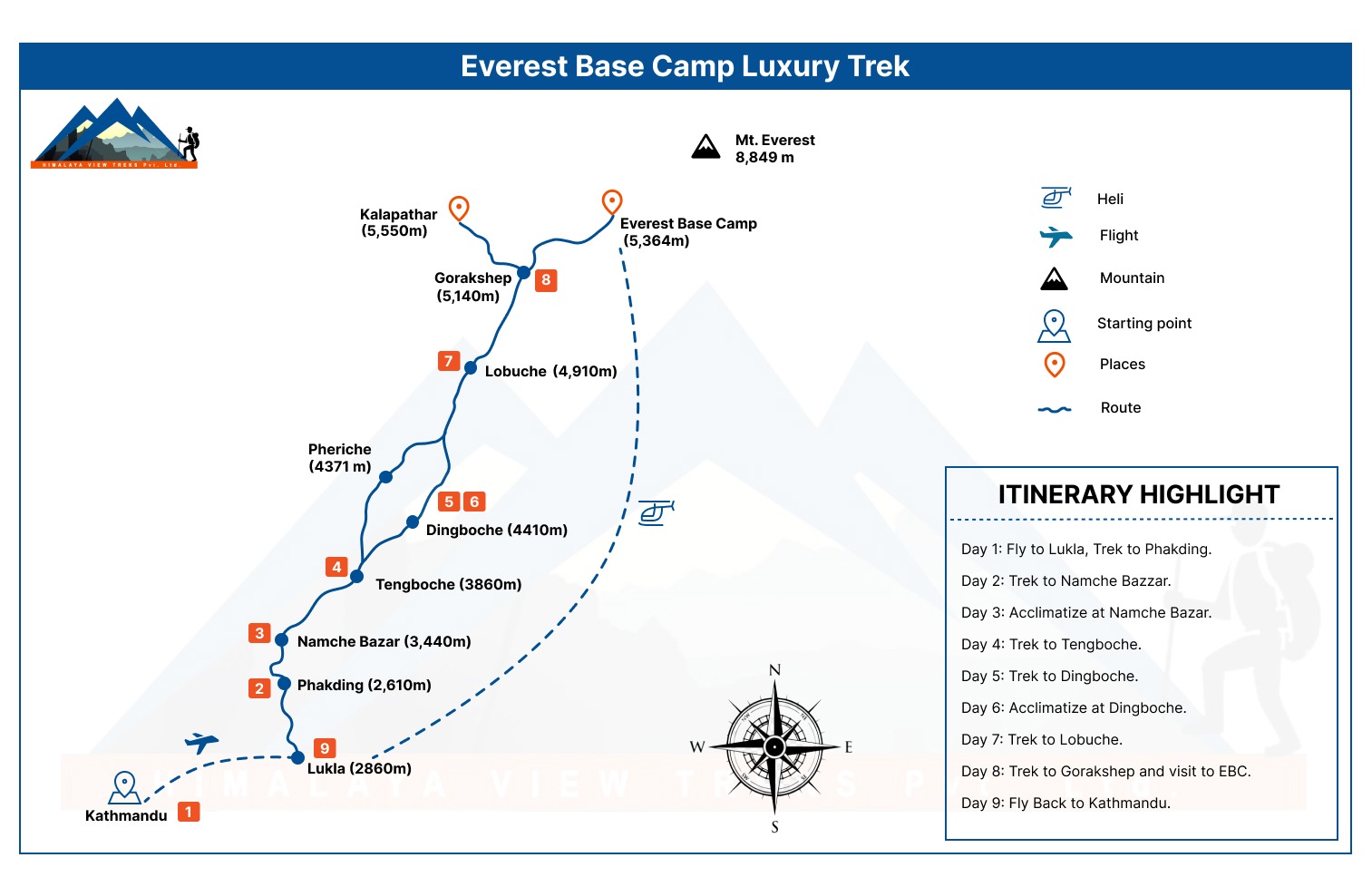
Day 1: Flight to Lukla and Hike to Phakding
First, you take a short scenic flight from Kathmandu to Lukla. You meet your trekking crew and begin walking along the Dudh Koshi River. Later, you arrive in Phakding and settle into a luxury lodge.
Day 2: Hike to Namche Bazaar
Next, you walk through pine forests and cross high suspension bridges. You enter Sagamartha National Park before tackling a steep climb up to Namche Bazaar. Afterwards, you check into a top resort featuring mountain views.
Day 3: Rest Day in Namche Bazaar
Today, you spend time resting so your body adapts to the altitude. You can explore local bakeries, visit museums, or walk to the Everest View Hotel. Meanwhile, you sip hot tea while admiring Everest from a distance.
Day 4: Hike to Deboche
The trail continues along scenic ridges with views of Ama Dablam. Soon, you reach Tengboche and visit its famous Buddhist monastery. Afterwards, you walk down to Deboche for a quiet evening at a cozy lodge.
Day 5: Hike to Dingboche
As you trek higher, the path climbs above the tree line into alpine terrain. You walk past stone walls and high yak pastures. Eventually, you arrive in Dingboche and relax inside a warm room.
Day 6: Rest Day in Dingboche
You take another crucial rest day to acclimatize safely. Furthermore, you can take an optional short hike up the ridge for views of Makalu and Island Peak. Rest helps your body prepare for higher elevations.
Day 7: Hike to Lobuche
The path leads past the poignant Everest Memorial site. Next, the trail grows steep and rocky as you approach the Khumbu Glacier. Finally, you reach Lobuche and rest at a luxury lodge.
Day 8: Hike to Gorak Shep, Visit Everest Base Camp, Fly to Lukla
You set off early toward Gorak Shep and drop off your heavy bags. Next, you hike directly to Everest Base Camp at 5,364 meters. You stand on the famous glacier and capture unforgettable photos. Afterwards, you return to Gorak Shep, board a helicopter, and fly down to Lukla.
Day 9: Flight Back to Kathmandu
In the morning, you board a flight from Lukla back to Kathmandu. Once in the city, you transfer to your hotel and spend the day relaxing or sightseeing.
How to Prepare for Your Trek
You do not need prior mountaineering experience or technical climbing skills for this trip. However, maintaining good fitness makes the daily walking far more enjoyable.
Cardio Workouts: Start running, swimming, or cycling two months before your trip.
Leg Conditioning: Practice squats, lunges, and stair climbing to build leg strength.
Trekking Boots: Purchase sturdy hiking boots early so you can break them in before arriving in Nepal.
Hydration Habit: Drink 3 to 4 liters of water daily during your training sessions to prepare for high altitudes.
Book Your Trip Today
Himalaya View Treks handles all your permits, flights, hotel bookings, and helicopter transport. Contact our expert team today to schedule your ultimate luxury trek to Mount Everest!
Luxury Everest Base Camp Trek Cost Breakdown
Before booking, explore our detailed Everest Base Camp Deluxe Trek Cost Breakdown. It clearly explains permits, flights, meals, accommodations, and guide fees. Additionally, you will see how luxury options differ from standard packages. This guide helps you plan your travel budget with confidence.
Short Itinerary
Luxury Everest Base Camp Trek - 9 Days Itinerary
Day 01 Fly to Lukla and then trek to Phakding walking distance of 6.2 km (3-4 Hours) 2,860 meters/9184ft ( Yeti Mountain Home )
Day 02: Phakding to Namche walking distance is 7.4 km (5-6 Hours) 3,440m/11,283ft ( Yeti Mountain Home )
Day 03: Acclimatization, Namche 440m/11,283ft ( Yeti Mountain Home )
Day 04: Namche to Diboche walking distance 6 km (6 hours) 3,730m/11946ft ( Himalayan Cultural Home Dibuche)
Day 05: Tengboche to Dingboche walking Distance 9.1km (6 hours) 4,400m/14,435ft ( Hotel Bright Star)
Day 06 Dingboche Acclimatization climbing the (5100 m) hill of Nagarshan (2/3 Hours) 4,400m/14,435ft ( Hotel Bright Star )
Day 07: Dingboche to Lobuche Walking distance 10 km (6-7 hours) 4,900m/16,076ft ( Italian pyramid in Lobuche )
Day 08: Lobuche to Gorakshep 4 km (6-8 hours) 5180m/16,994ft (Gorekshep) & 5364m/17598 Everest Base Camp) fly Back from Base camp by Heli. ( Yeti Mountain Home)
Day 09: We will fly from Lukla to Kathmandu (1300 m). 30 minutes.
Detailed Itinerary
Day 01: Fly to Lukla and trek to Phakding
Fly to Lukla 35 minute, (2840m) and Trek to Phakding. Altitude of Phakding (2610m): After a short flight trek to Phakding. Walking distance 3/4 hour stay overnight at Yeti Mountain Home.
Day 02: Journey to Namche Bazar Via Manju, Jorsalle, Hilary bridge,
Journey to Namche Bazar Altitude of Namche bazar (3440m) Via Manju, Jorsalle, Hilary bridge, Top danda which is first Everest viewpoint, to Namche Bazar Walking distance 5/6 hour stay overnight at Yeti Mountain Home.
Day 03: Namchebazar: acclimatize day
Namchebazar: acclimatize day, hike to Syanbuche which is the Viewpoint of Mt. Mount Everest, have some drinks and explore around the Everest Region Mountain such as Everest (8848m.) Lhotse (8516m.), Amadablam (6812m.), Nuptse (7855m.), Island (6189m.) etc, stay in the same Hotel. Yeti Mountain Home.
Day 04: Trekking to Diboche Via Tengboche Monastery
Trek to Diboche Via Tengboche Monastery Altitude of Tengboche (3860m) via phunky tanka, Late afternoon explore the enchanting and biggest Buddhist monastery of the area. Walking distance: 5/6 hour stay overnight at Best Hotel in Diboche.
Day 05: Trekking to Dingboche via Dibuche, Somare, to Dingboche
Trek to Dingboche Altitude of Dingboche (4300m) Trekking trail Via Diboche, Somare, to Dingboche check-in room and then have some hot drink to make warm for body and hike around Dingboche Ri for acclimatizing. It make you better sleep at night, Walking distance 5/6 hour stay overnight at Hotel Bright Star.
Day 06: Dingboche: acclimatization day
Dingboche: acclimatize day, hike to Nagarshan hill explore the areas and back to Dingboche overnight at the same hotel.
Day 07: Trek to Lobuche via Thukla to Lobuche
Trek to Lobuche Altitude of Lobuche (4960m): via Thukla to Lobuche same as a past day we can do a little hike surrounding the Lobuche and back to the hotel, Walking distance 5 to 6-hour stay overnight at best Loudge in Labuche.
Day 08: Journey to base camp of Everest via Khumbu glacier
Journey to base camp of Everest Altitude of Everest Base Camp (5400m) via Khumbu glacier to Everest base camp, explore the Area and Heli back to Lukla stay overnight at Yeti Mountain Home..
Day 09: Fly back to Kathmandu from Lukla
Fly back to Kathmandu from Lukla in the morning (35 minutes). Overnight at your own Hotel in kathmandu.
Included
- Airport pickup and drop as per client’s arrival and departure date
- Hotel- domestic airport- hotel by car/ van, depend on group sizes
- Both ways Flight Ticket Lukla - Kathmandu) tickets including airport taxes
- All meals (Breakfast, lunch, and dinner) during your Everest Base Camp Luxury Trek
- 8 nights Hotel Accommodation during Everest Base Camp Luxury Trek
- Government licensed holder, fluent English Speaking, Familiar HVT guide
- One assistant guide if Group sizes is more than 10 trekkers)
- Strong local Porters for Carry trekker’s luggage One porter every 2 trekkers
- Guide and porter wages including their meals, accommodation, and Salary
- Staff insurance including medication coverage
- Guide and Assistance flight Ticket
- Equipment for the Company staff
- Water purification drop or tablets for safe drinking water
- Sagarmatha National Park entry permit fee
- Khumbu Pashang Lhamu Rural Municipality permits fees
- Seasonal fresh fruits every day during Everest Base Camp Luxury trek
- Oximeter to measure Pulse and oxygen level
- Company T-shirt as a Souvenirs, and duffle bag if needed
- Local government, taxes, including official Service Charge
- Trip completion Certificate
Not Included
- Hotel accommodation and meals In Kathmandu.
- Personal expense (shopping, snacks, boil bottle water, hot (tea, coffee) and cold drinks, hot shower, alcohol, Wi-Fi, telephone call, battery charge fee during the Everest base camp Trek)
- Personal clothing and trekking gear
- Personal travel insurance including evacuation coverage (compulsory) up to 6000m)
- Additional costs if delays flights and outside the itinerary
- All the costs and expenses which are not mentioned in includes list.
- Tips for guide and porters. in end of the treks
Useful Info
Everest Base Camp Luxury Trek Highlights:
- Trek to the iconic Everest Base Camp with support from our experienced team of guides, crew and porters who simply love what they do.
- Climb Kalapathar (5545m) for grandstand views of Everest, Lhotse, Nuptse and surrounding peaks. The sights hereabouts are some of the best in the world.
- Experience the breathtaking mountain flight to Lukla, you’ll love it.
- Immerse yourself in colourful ancient Kathmandu with an optional s/seeing
- Experience the warmth and hospitality of the Sherpa people. Interact with them to learn of their lifestyles & traditions as they survive in harsh conditions for all of their lives.
Is this your ideal trek?
Trekking in the Everest region is all about altitude. By its very nature adventure travel involves that you be prepared for the unexpected. In far-flung and developing countries do not expect standards you are used to at home. Remote areas are sometimes unpredictable and itineraries may be altered. To enjoy your trip and get the most out of your adventure it is important that you are flexible, positive and eager to take on all the challenges that arise from your Everest base camp odyssey. If you’re a greenhorn in the wilderness world then this trek would be ideal for you.
To truly enjoy this trip, you should be pretty habituated to walking 4-6 hours each day for several days on the go while some days will be relatively longer. We encourage you to walk at a pace that suits you without any rush whatsoever. This is a key aspect of enjoying such trips in the planet’s most popular region. You ought to be physically fit and an active walker to get the best of this classic mountainous journey to the south side of the mighty Everest.
General information important to this trip:
Difficulty levels
TREKKING AT HIGH ALTITUDES (over 3500m)
This trip includes strenuous trekking at altitudes of over 3500m. For us altitude is a very serious issue, a result that has kept our records clean making us one of the best adventure operators in Nepal for over 30 years of operating treks in the region. Our trekking guests must be in great health and have high fitness levels to attempt this trip, as well as be committed to train to ensure you are suitably physically prepared for the tough challenges that go above 4500m.
Altitude sickness is a risk for anyone, including on the Annapurna, Langtang and Everest Base Camp treks. Please make sure you familiarise yourself with signs and symptoms before you depart and monitor your own health during your trek, without letting it worry you.
We advise all our guests to undergo a thorough medical with your personal physician before you embark on this trip.
Participating in a group trip
When you travel with a group you will find much camaraderie and all the fun and also there’s bound to be some of the frustrations of travelling in a group. Your group mates will probably come from all corners of the world and you will come across a range of age groups too. We ask you to be understanding of the various needs and preferences of your group - patience with your fellow travellers is sometimes required for the benefit of everyone's travel experience. Remember too that you have responsibilities to the group. If you are requested to be at a place at a certain time, ensure you’re on time without keeping the rest of the group waiting. Experience has taught us often that the very best trips we operate are those where the chemistry within the group work well - this simply requires a ‘give a little take a little’ attitude effort on your part. For privacy reasons we are unable to provide you with contact details and any personal information about your fellow travellers booked on your trip prior to departure.
TRAVELERS who prefer going SOLO:
Our group trips are generally planned for shared accommodation and don't involve single supplements. Single travellers share with people of the same gender in accommodation ranging from twin to multishare. Some of our itineraries have accommodation booked on a mixed gender share basis [for couples or trekkers known to each other prior to the trip]. On a selection of our trips, you have the option to pay a single supplement to ensure that you have your own accommodation (where available). Please note that this only applies to accommodation during the trek - pre-trip and post-trip accommodation will be booked on a single room basis at your hotel in Kathmandu. We also have arrangements for guests who wish to trek completely solo out of the group.
Travel Insurance
when booking with Himalaya View Treks, it’s a condition upon joining any of our trips where all clients must be insured for comprehensive expenses that might incur due to medical issues or accidents (this includes air ambulance, helicopter rescue, and treatment costs). Please note that we don't arrange or sell insurance because such a system is not allowed in our country.
Our Cost versus the Experience
At Himalaya View Treks, we always go the mile to ensure our trekking guests get the best experiences of the trip with maximum comfort and safety on a ratio that goes beyond the cost that we charge for the trip. We provide a ‘no frills’ price with breakdowns to make sure our client are getting the best for a cost that goes beyond all expectations
Tipping [an expectation on such risky arduous trips]
Tipping is very much part of the culture in Nepal and although entirely at your discretion, it is usually expected. Often people would like to tip in recognition of good service but are unsure how much would be appropriate in a foreign country - for this reason, we have listed guideline amounts below (these are intended as a guideline only and you may see fit to give more or less depending on the service that you have received).
For the tipping of your trek staff and your tour leader, we suggest passing an envelope for each staff member around the group so that everyone can put in what they feel comfortable with anonymously.
The following are guideline amounts received by each staff member from the group as a whole...
- Tour Leader: Rs30, 000 - 35,000 (usually tipped on the last night in Kathmandu)
- Your trekking crew (tips are usually given on the last evening of the trek in Lukla):
- Head Trekking Guide and Assistant Guides: Rs20, 000 - 25,000 for each guide
- Trek Porters/yak men: Rs10, 000 for each porter or yak man
Acute Mountain Sickness [AMS]
When we ascend above 2500 metres our bodies have to acclimatise to the decreasing amount of the oxygen available. So, to allow our bodies to adjust we have designed our treks in ways that help you ascend slowly, allowing acclimatisation to occur when you go above the tree lines where the air is thinner. However, during the acclimatisation process, you may experience some of the following symptoms.
- Headache
- Tiredness
- Disturbed sleep patterns
- Loss of appetite/nausea
- Shortness of breath
- Cough
- Palpitation
- Swelling of the hands and face
But if you feel such symptoms don’t let it worry because it’s normal. Individuals acclimatise at different rates. Some may experience symptoms, some may not. Your best strategy is to take your time and drink plenty of water. These symptoms may not indicate the onset of A.M.S. and if you experience them it does not necessarily mean that you should not continue. All our group leaders have extensive first aid training and we urge you to communicate with the group leader at all times should you believe you have any symptoms in order that we can effectively monitor your symptoms as you go higher. The only cure for Acute Mountain Sickness is to descend. Please note, that your group leader has ultimate responsibility and may ask you to descend if symptoms persist. As a last resort, if matters grow from bad to worse, we always have a helicopter on standby for immediate evacuation.
A Typical Day on the Everest Base Camp Trek
A typical day on the trail begins with a wake-up call at around 6 AM by your guide. Freshen up and get ready. Pack your belongings and head to the dining area for breakfast by 7 AM. Check your luggage for the final time and fill your water bottle before you hit the trail by 8 AM, along with your guide.
To avoid walking in the heat and enjoy clear mountain views, you make an early start. En route, there will be short breaks to enjoy the views and take photographs. You haul up for lunch at a local teahouse around noon or mid-day. After a quick rest of about an hour or 40 minutes, you get back on the trail and continue till you reach your overnight stop.
Upon reaching the stop for the night, you head to your teahouse, check in, and have some rest. Tea with some light refreshments (cookies or biscuits) will be served at 5 PM. As the rooms are not insulated, you can warm yourself by the heater or stove in the communal area.
Exchange stories or play cards with other trekkers and sherpas till dinner is served (around 7 PM). After dinner, your guide will brief you about the next day’s trek – the route you will take, difficulties, where you will stop for lunch, etc. Afterward, retire for the night and have a well-deserved rest.
On average, you may have to walk 6 to 7 hours daily. The trek to Phakding is the shortest and the easiest, while the hike to Everest Base Camp from Lobuche on the 9th day could be your toughest. On Day 10, a hike to Kalapathar for the sunrise view is scheduled. So you will have to wake up before 4 AM to reach Kalapathar before sunrise. Your guide will share the details regarding the hike during the after-dinner briefing on Day 9.
Trip Map